
Crash games are one of the fastest-growing formats in online crypto casino gambling. The mechanic is simple; a multiplier rises, you cash out before it crashes, and whatever multiplier you locked in is your payout. But when you put that mechanic inside a crypto casino tournament structure, the game changes. Literally.
A crash casino tournament takes an already high-adrenaline game and adds a leaderboard. You're no longer just playing against the house, you're competing against other players for a share of a prize pool. And depending on how the tournament scores your performance, the strategy shifts in ways most players never think about.
This guide covers how crash games work, every major crash game tournament scoring model used across the industry, and the strategy behind each one, whether you're entering your first tournament or trying to crack the top 10 on a crypto casino tournament leaderboard.
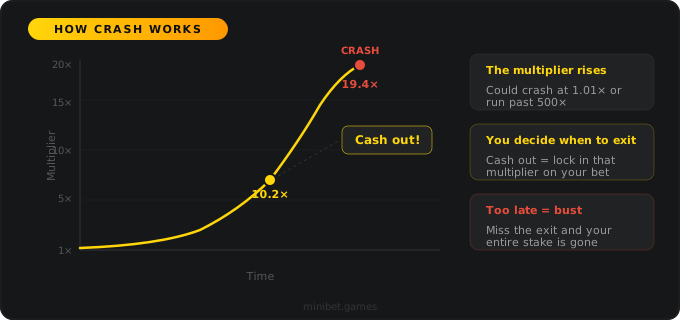
If you've never played a crash game before, here's the core loop.
A round starts. A multiplier begins climbing - 1.00×, 1.10×, 1.50×, 3.00×, 10.00×, higher. At any point, you can cash out and lock in that multiplier on your bet. If you don't cash out before the game crashes, you lose your stake. That's it.
The crash point is random. It could crash at 1.01× or run past 500×. A provably fair crash game uses cryptographic hashing to determine the crash point before the round begins, meaning the outcome is verifiable after the fact, neither the player nor the platform can manipulate it. This is one of the core trust mechanisms behind any crypto crash game worth playing.
The crash game RTP (return to player) typically sits between 95% and 99%, depending on the game. That RTP is baked into the distribution of crash points: most rounds crash low (under 2×), some run to moderate multipliers, and a small percentage run high. The crash game house edge is the inverse of the RTP; If RTP is 97%, the house edge is 3%.
Understanding crash game odds means understanding that distribution. You're not predicting when the crash happens. You're making a decision, cash out now at a sure thing, or hold for a bigger number that might never come.
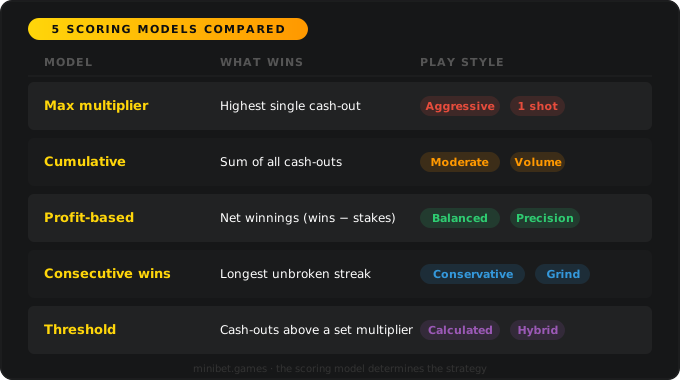
Not all crash casino tournaments are scored the same way. The scoring model is the single most important thing to understand before you enter one, because it determines what "good play" actually looks like. Here's every major crash game tournament scoring format used across the industry.
1. Max Multiplier
The simplest format. Your score is the single highest multiplier you successfully cash out at during the tournament period. One moment defines your finish. The player at the top of the crash game leaderboard is whoever locked in the biggest number.
What it rewards: Pure risk appetite. You need to let the multiplier run deep and cash out at the right moment. Conservative 2× cash-outs will never win this format — you need to hit 50×, 100×, or higher.
Strategic implication: This is a high-variance format. Most of your rounds will contribute nothing to your score — you're hunting for one monster cash-out. Bankroll management matters because you need enough rounds to give yourself shots at a big multiplier without going broke before it happens.
2. Cumulative Multiplier
Your score is the sum of every multiplier you successfully cash out at during the tournament period. Cash out at 3× five times and your score is 15. Cash out at 50× once and bust 20 times, your score is 50.
What it rewards: Consistency and volume. A player who cashes out at moderate multipliers (5×–15×) across many rounds can build a competitive score without ever needing a single huge hit.
Strategic implication: This is the format where crash game bankroll management matters most. You need to play a lot of rounds, which means sizing your bets to sustain a full session. Busting doesn't subtract from your score, it just wastes a round and eats your bankroll.
3. Profit-Based / Net Winnings
Your score is your total profit: all winnings minus all stakes. Similar to how live casino tournaments are scored at some platforms. If you bet $100 across 20 rounds and your total payouts are $140, your score is +40.
What it rewards: Sustainable winning. Every bust actively hurts your score because your stakes keep accumulating while your winnings don't. You can't just volume-grind your way to the top, you need to actually come out ahead.
Strategic implication: The most punishing format for reckless play. A losing streak here digs a hole that's hard to climb out of. Players who combine moderate risk with strong timing tend to finish highest.
4. Consecutive Wins
Your score is your longest unbroken streak of successful cash-outs. The multiplier you cash at doesn't matter, only that you cashed out at all. Win 12 rounds in a row at 1.5× each and your score is 12.
What it rewards: Conservative, disciplined play. This is the only format where cashing out at 1.1× is a legitimate strategy, because every successful cash-out extends your streak, regardless of size.
Strategic implication: The crash game auto cashout feature at low multipliers (1.2×–1.5×) is arguably optimal here. The lower your target, the higher the probability of successfully cashing before the crash. But the game still crashes below 1.1× occasionally, so even the most conservative streak will eventually break.
5. Multiplier Threshold
Your score is the number of times you successfully cash out above a set threshold, typically 5×, 10×, or 20× depending on the tournament. Cash out at 12× in a 10× threshold tournament and it counts. Cash out at 8× and it doesn't.
What it rewards: Repeated calculated risk. You can't just cash out early for safety (below the threshold it doesn't count) and you can't just hit one big number (you need multiple qualifying cash-outs). This is the hybrid format, risk and consistency together.
Strategic implication: Your target multiplier is fixed by the tournament rules. The strategy becomes about round selection and bet sizing: how many shots can you afford, and how do you maximise the number of times you cross the threshold without busting?
Most crash game tips you'll find online boil down to "cash out early" or "ride the wave." Neither is useful. The real crash game strategy depends entirely on which scoring model the tournament uses — and even within a format, there are decisions that separate leaderboard players from everyone else.
Here's how to think about it like someone who competes, not just plays.
Match Your Risk Profile to the Format
There's no single best crash game strategy. There's a best strategy for the format you're in.
In a max multiplier crash game tournament, conservative play is a losing approach. You need high-risk rounds where you let the multiplier run deep. That means accepting that most rounds will end in a bust, you're playing for the one where it doesn't.
The crash gambling strategy here is about shot selection: how many rounds can you afford to take swings on, given your bankroll?
In a cumulative format, flipping the other way works. Consistent 5×–15× cash-outs, round after round, build a score that aggressive players can't match unless they get lucky repeatedly. Volume is the weapon.
In a profit-based format, crash game risk management becomes critical. Every bust costs you real points. The strategy shifts toward fewer, higher-conviction rounds rather than spraying bets and hoping.
Auto Cashout vs. Manual - The Tactical Lever
The crash game auto cashout feature lets you set a target multiplier before the round starts. If the game reaches that number, it cashes you out automatically. No hesitation, no greedy override.
For consecutive wins and threshold scoring, auto cashout is arguably the strongest tool available. Set it at 1.3× for a consecutive format and you remove emotion entirely, every round either hits your target or it doesn't. For threshold scoring, set it just above the qualifying multiplier (if the threshold is 10×, set auto at 10.5×) to lock in qualifying cash-outs without risking an extra second of exposure.
For max multiplier formats, auto cashout is a leash you probably don't want. The upside is uncapped, you need to ride the wave manually when a round starts running hot. The downside: greed. The round hits 80× and you hold for 100×, then it crashes at 87×. Manual play is optimal in theory, punishing in practice.
Bankroll Allocation - How Much Per Round
This is the crash game tip that actually matters: sizing your bets so you can survive the session.
In a max multiplier tournament, you don't need every round to count, you need one round to count. That means smaller bets, more rounds. If your bankroll for the session is $100, bet $2–$5 per round. You're buying 20–50 shots at a big number. Blow $25 on your first round and bust, and you've just cut your opportunity set in half.
In a cumulative format, bet sizing is more uniform. Every round contributes, so consistent stakes make your score accumulate predictably. Flat betting (same amount every round) is a solid default.
In a profit-based format, sizing down after losses and sizing up slightly when you're ahead protects your net. This isn't a "system", it's just the mathematical reality of how net winnings scoring punishes drawdowns.
The "One More Round" Trap
This is where most crash game tournament players lose their position.
You're sitting 7th on the leaderboard. There's an hour left. You've got a decent score. The temptation is to keep playing, one more big round could push you to 3rd.
But in a max multiplier format, your current best cash-out is already locked in. Playing more rounds can't improve that score unless you beat it, and every round you play is another chance to tilt, oversize a bet, and drain the bankroll you might need for a different tournament day.
In a profit-based format, it's worse: every round you play and lose actively reduces your score. Sometimes the smartest crash game strategy is patience and timed play.
The Bust Rate Reality
At 2× target, you succeed roughly 50% of the time. At 10×, roughly 10%. At 50×, roughly 2%. At 100×, roughly 1%. These aren't exact (they depend on platform RTP and the crash distribution), but the shape holds.
What this means: if you're targeting 10× in a max multiplier format, you should expect to bust roughly 9 out of every 10 rounds. Your bet size needs to account for that. If it doesn't, your bankroll dies before the math has time to work.
This isn't a system. It's a framework for thinking about crash game tournament decisions without fooling yourself about the odds.
Minibet runs its crash game tournament as the Crash Circuit, one of four weekly circuits in a full 52-week competitive season alongside the Slots Circuit Casino Tournament, Live Casino Circuit Tournament, and Fishing Circuit Tournament.
The Crash Circuit uses max multiplier scoring. Your position on the leaderboard is determined by the single highest multiplier you successfully cash out at during that week. One moment, one number, one shot at the top.
Each week, the top 10 players share $2,000 MBUSD in prizes. Entry is automatic, your first qualifying bet enters you onto the leaderboard. Mega Circuit weeks (weeks 13, 26, and 39) raise the pool to $3,000 MBUSD with 20 winners. The Week 52 Championship pays $5,000 MBUSD to the top 50 players. Across all four circuits, the season totals $440,000 MBUSD in prizes with minimum wagering requirements.
If the max multiplier format sounds like your kind of competition, high stakes, one big moment, strategy that rewards patience and timing over volume, the Crash Circuit is where it plays out every week.
Run the Circuit. Own the Week.
How do crash casino tournaments work? A crash casino tournament is a timed competition where players earn scores based on their crash game performance over a set period. The scoring model varies, some tournaments score your highest single cash-out, others sum all your cash-outs or measure your net profit. Top finishers on the leaderboard share a prize pool.
How to win crash game tournaments? There's no guaranteed way to win, but understanding the scoring model is the closest thing to an edge. Match your risk profile to the format: aggressive play in max multiplier tournaments, consistent play in cumulative formats, and disciplined loss management in profit-based formats. Bankroll allocation (how much you bet per round) matters more than most players realise.
What is the best crash game strategy? It depends on the tournament scoring format. In a max multiplier format, the strategy is about shot selection — small bets, many rounds, waiting for one big cash-out. In a cumulative format, consistent 5×–15× cash-outs build a competitive score. In profit-based formats, minimising losses is as important as maximising wins.
How does crash game auto cashout work? Auto cashout lets you set a target multiplier before a round begins. If the game reaches your target, it cashes you out automatically without any manual input. This removes emotional decision-making and is particularly useful in consecutive wins and threshold scoring formats.
What is a good crash game multiplier to cash out at? That depends on the tournament format and your strategy. In a max multiplier tournament, you need to let the multiplier run high, there's no point cashing at 3×. In a cumulative tournament, consistent 5×–15× cash-outs are more valuable than chasing one big number. There's no universally "good" multiplier, only good multipliers for the format you're competing in.
What is a provably fair crash game? A provably fair crash game uses cryptographic algorithms to determine crash points before rounds begin. After each round, players can verify the outcome using a hash seed, confirming that neither the platform nor other players influenced the result. It's a trust mechanism native to crypto casino platforms.
Are crash games just luck? The outcome of any single round is random, yes. But tournament play introduces strategic decisions that pure luck doesn't cover: how much to bet per round, when to cash out, when to use auto cashout, and how to allocate your bankroll across a session. The scoring format determines which of those decisions matters most.
Gambling should be fun. If it stops feeling that way, help is available. Visit BeGambleAware.org or call the National Gambling Helpline on 0808 8020 133 for free, confidential support.
This content is for informational purposes only. Betting involves financial risk. Please play responsibly.