Before you spin a slot or drop into a crash game, there's one number worth knowing. It won't tell you whether you'll win tonight. But it will tell you a lot about the game you're playing, and whether it's working for you or against you.
That number is RTP. And once you understand it, you'll never look at a casino game the same way.
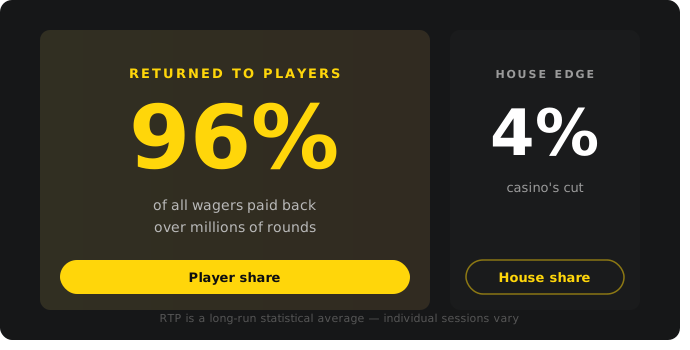
RTP (Return to Player) is the percentage of all money wagered on a game that gets paid back to players over time. A game with 96% RTP returns $96 for every $100 wagered, on average, across millions of rounds. The other 4%? That's the house edge, the casino's cut.
It's the single most useful piece of information available to any player. And most people never check it.
RTP stands for Return to Player. It's expressed as a percentage, and it represents the theoretical long-term payout rate of a casino game.
Here's a simple way to think about it: Imagine 1,000 players all wagering $100 on the same slot with a 96% RTP. Across all those players, the game returns $96,000 of the $100,000 wagered. Some players win big. Some lose everything. But pooled together, $96 in every $100 finds its way back to players over time.
That word "over time" is doing a lot of heavy lifting in that sentence. We'll come back to it.
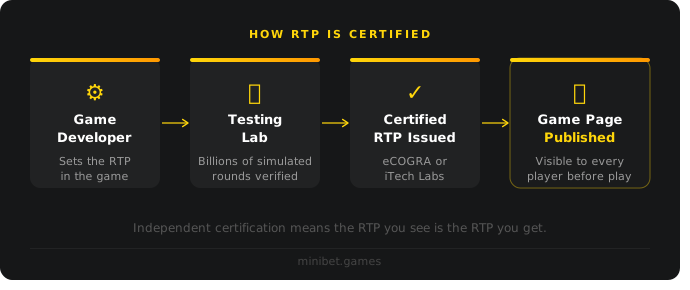
RTP is set by the game developer, verified by independent testing labs, and published for every certified casino game. It's not a marketing figure. It's a regulatory standard.
Game developers calculate RTP by running their games through billions of simulated rounds, far more than any real player will ever see in a lifetime of playing.
The process works like this: the developer maps out every possible outcome in the game, every winning combination, every bonus trigger, every multiplier. They then calculate the total expected return from all of those outcomes, divide it by total stakes, and arrive at the RTP percentage.
Once a game is built, that RTP is tested and certified by independent auditing bodies (organisations like eCOGRA or iTech Labs) before the game is ever released to players. Their job is to verify that what the developer claims is actually what the game delivers.
What this means practically: RTP is a long-run statistical average, not a session-by-session promise. In any single session, you could win four times your stake or lose everything. The 96% figure smooths out across millions of real-world spins, not the hundred or two hundred you might play in an evening.
That's not a flaw in the system. It's just how probability works.
You'll often see both terms used when casino games are discussed. They're two sides of the same coin.
RTP is the player's share; the percentage returned to players over time House edge is the casino's share; the percentage the house keeps over time
They always add up to 100%. A game with 96% RTP has a 4% house edge. A game with 99% RTP has a 1% house edge. The house edge isn't unique to online casinos, every form of gambling has one. What matters is knowing what it is before you play, so you can make informed choices about where you put your money.
Lower house edge = more value for players. It's that simple.
Here's a practical benchmark: Below 94% = Considered low, the house edge is working hard against you 94%–96% = Average, playable but average value 96%–97% = High RTP, this is where most slots sit 97%–98% = Very High RTP, genuinely player-friendly Above 99% = Exceptional, rare, and worth seeking out
Most online slots sit between 95% and 97%. Anything above 97% puts you in good territory. Anything pushing 98% is genuinely exceptional, and worth looking for.
At Minibet, many of the Minibet Originals have RTP grater than 99%. For example, Crash by Minibet Studios runs at 99% RTP, one of the highest available at any crypto casino. There are many more High RTP Casino Games available such as Cai Shen Fishing by JDB at 97%, Piggy Tap by Onlyplay at 96.98%, Lucky Chicken Crossing by Jacktop at 99%, and so on.
These aren't cherry-picked for the sake of a good headline. They're examples of what to look for when you're choosing where to play.
Sometimes, yes.
Many game providers offer casinos a configurable RTP range. For example, a slot might have a base RTP of 96% but allow the casino to set it anywhere between 94% and 96% depending on their configuration. Some casinos choose the higher end. Others don't.
This is why it matters where you play, not just what you play.
Reputable crypto casino platforms publish the RTP for each game directly on the game page so players can see exactly what they're getting before they wager. No guesswork, no digging through small print.
If a casino doesn't display RTP figures, that's worth paying attention to.
RTP and volatility: why both matter RTP tells you how much a game pays back over time. But it doesn't tell you how it pays back. That's where volatility comes in.
What is Volatility (sometimes called variance)? It describes the rhythm of a game's payouts:
Low volatility: frequent small wins, your balance stays relatively steady, but big wins are rare High volatility: infrequent wins, but when they hit, they hit harder. Longer dry spells, bigger peaks Medium volatility: somewhere in between
A game can have excellent RTP and still be brutal in the short run if the volatility is high. And a low-volatility game with decent RTP can be a comfortable, low-stress play even if the jackpots aren't massive.
The ideal combination depends entirely on what kind of player you are. Neither is objectively better, they're just different experiences. Understanding both gives you actual control over how you play.
(We'll cover volatility in detail in our upcoming guide for volatility, worth a read once you've got the RTP basics locked in.)
RTP won't tell you whether tonight's session goes your way. No number can. What it does tell you is whether the game you're sitting down at is built to give you a fair shot over time, or not.
Check it before you play. Look for 96% as your floor. Aim for 97% and above when you can. And when you find 99%, that's a game that's working with you, not against you.
Explore High RTP Slots, Crash, Instant Wins and more at Minibet, including Crash at 99% RTP, one of the most player-friendly games available at any crypto casino. Or browse the full Live Casino collection and find your next game with the numbers already on your side.
New to crypto casinos altogether? Start with our guide: What Is a Crypto Casino? How It Works & Why Players Are Switching.
Is 96% RTP good for a slot? Yes, 96% is considered standard for online slots. Anything above 97% is high, and 99%+ is exceptional. As a rough rule of thumb, don't go below 95% if you can help it.
Does RTP mean I'll win 96% of my money back? Not per session. RTP is calculated over millions of spins, your individual session can look very different from the long-run average. You might have a great run, you might hit a rough patch. The 96% figure describes the game's behaviour across the lifetime of all players, not the next hundred spins.
Can a casino change a game's RTP? Some providers allow casinos to select from a configured range. A transparent casino will display the RTP for each game so you always know what you're playing with.
What is the highest RTP casino game? Crash by Minibet Studios runs at 99% RTP, one of the highest available at any crypto casino. Certain blackjack variants with optimal play can reach similar levels, though the RTP in table games depends heavily on strategy.
What's the difference between RTP and volatility? RTP tells you the percentage returned over time. Volatility tells you how often and how big those returns are. A 97% RTP high-volatility slot plays very differently from a 97% RTP low-volatility one, even though the long-run return is the same.
Do crypto casino games have better RTP than regular casinos? Often, yes. Crypto casinos tend to have lower operational overheads than traditional online casinos, and many pass that on through higher RTP configurations. At Minibet, games like Crash sit at 99% RTP, significantly above the industry average.
Gambling should be fun. If it stops feeling that way, help is available. Visit BeGambleAware.org or call the National Gambling Helpline on 0808 8020 133 for free, confidential support.
This content is for informational purposes only. Betting involves financial risk. Please play responsibly.