-desktop-image-6rclbv.webp)
-mobile-image-kwrz1n.webp)
An online slot is a digital casino game where you spin a set of reels and win when matching symbols land on a payline. That's the surface-level version, and it's technically accurate, but there's significantly more going on underneath it. The random number generator that determines every outcome, the RTP that defines the long-run maths, the volatility that shapes how your session actually feels, and the bonus features that make one slot play completely differently from another: understanding how online slots work at that level turns you from someone pressing a button into someone who knows what they're pressing it for. This online slots guide covers all of it, written for slots beginners who want the full picture rather than just the instructions.
If you're exploring the broader world of online casino games, slots are the largest category by far. Most crypto casinos carry thousands of them across dozens of providers, and the mechanics covered here apply to virtually all of them.
Every online slot is built around a grid. The most common layout is a 5-reel, 3-row grid (five vertical columns, three symbols visible per column), but modern slots come in every shape from 3×3 to 6×5 and beyond. Some don't use a traditional grid at all, opting for cluster mechanics or cascading systems instead.
Here's what you're looking at on screen:
Reels are the vertical columns that spin when you hit the button. Each reel carries a set of symbols, and when the reels stop, the visible symbols determine whether you've won. On a classic 5-reel slot, five columns stop independently.
Rows are the horizontal lines of symbols visible after the spin. On a 3-row slot, you see three symbols per reel, giving you a 5×3 grid of 15 symbols total.
The bet controls sit below the grid. You'll see options for adjusting your bet size (either per line or total bet), a spin button, and usually an autoplay option that lets the game spin automatically for a set number of rounds.
The balance display shows your current funds, total bet, and last win. On online slot machines, these are typically displayed in whatever currency the platform uses.
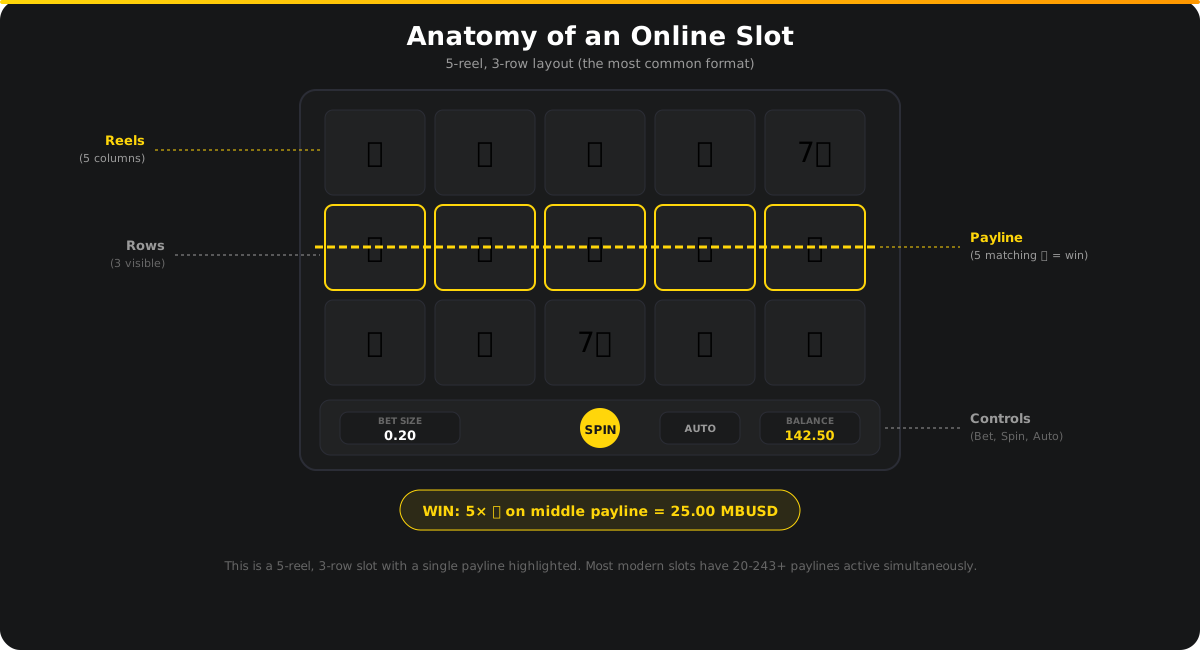
A payline is a pattern across the reels that defines a winning combination. If matching symbols land on positions that follow a payline's pattern, you win. If they don't, you don't. That's the core mechanic.
Classic slots had a single payline running straight across the middle row. Modern online slot machines have evolved well beyond that, and the payline system now comes in three main flavours:
Fixed paylines are predetermined patterns that are always active. A slot might have 20, 25, 50, or even 243 fixed paylines. You don't choose which ones to activate; they're all live on every spin. Your bet is spread across all of them.
Ways-to-win slots replace traditional paylines entirely. Instead of following specific patterns, they pay whenever matching symbols appear on adjacent reels from left to right, regardless of their vertical position. A "243 ways" slot means every possible combination across 5 reels and 3 rows is a potential win (3 × 3 × 3 × 3 × 3 = 243). Some modern slots offer 1,024 ways, 4,096 ways, or even hundreds of thousands of ways to win.
Cluster pays slots ignore both paylines and adjacency rules. They pay when groups of identical symbols connect in a cluster anywhere on the grid (typically 5 or more touching symbols). Cluster pay slots often combine with cascading reels, where winning symbols disappear, and new ones fall into their place, creating chain reactions within a single spin.
The payline system matters because it determines how often you win and how the game calculates your payout. More paylines or ways means more frequent wins, but each individual win is typically smaller relative to your total bet.
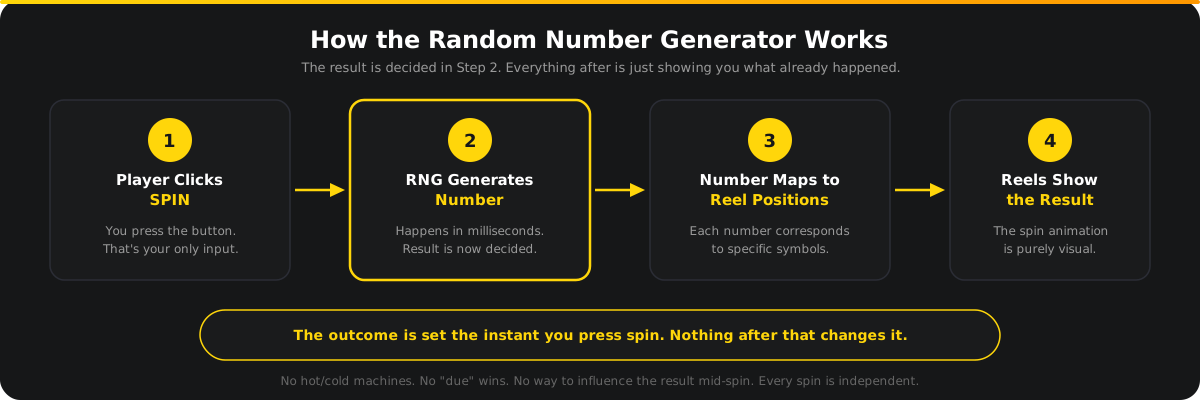
This is the single most important concept in slots, and the one that most players misunderstand: every spin is determined by a random number generator (RNG) system, and every spin is completely independent of the one before it.
Here's how it actually works:
The moment you click spin, the RNG generates a random number (or sequence of numbers) in a fraction of a millisecond. That number maps to a specific set of reel positions, which determines exactly which symbols appear in each cell of the grid. The spinning animation you see is cosmetic. By the time the reels start "spinning" on your screen, the result has already been decided.
This means:
There are no "hot" or "cold" machines. The RNG doesn't track previous results. A slot that hasn't paid out in 200 spins is not "due" for a win. A slot that just paid a big win is not "cold" now. Every spin is a fresh, independent event with the same probability distribution.
Nothing you do during a spin affects the outcome. Stopping the reels early, clicking faster, or switching between autoplay and manual spin doesn't change anything. The result was set the instant you pressed spin.
The RNG runs continuously. Even when nobody is playing, the RNG is generating numbers. This is why the exact millisecond you press spin matters: a fraction of a second later, the number would have been different. It's not rigged; it's just random.
Online slot machines at reputable platforms use RNG software that's independently tested and certified by third-party auditing firms. If you want to understand the provably fair alternative used in some crypto-native games like Crash, the what is a crash game guide covers that verification method in detail.
Every online slot has a published slot RTP (Return to Player), which tells you the percentage of all money wagered that the game is expected to return to players over time. If a slot has a 96% RTP, it means that for every 100 USD wagered across all players over millions of spins, 96 USD is expected to be paid back and 4 USD goes to the house.
A few critical things to understand about slot RTP:
It's a long-run average, not a per-session guarantee. An RTP of 96% doesn't mean you'll walk away with 96% of your money after an hour of play. In any given session, you might 10X your balance or lose it all. The percentage describes what happens over millions of spins across all players, not what happens to you specifically on a Tuesday afternoon.
Higher RTP means a smaller house edge. A 97% RTP slot has a 3% house edge. A 94% RTP slot has a 6% house edge. That's double the cost over time. Checking the RTP before playing is the single easiest way to make a better-informed choice about which slot to play.
RTP doesn't tell you how a session will feel. That's what volatility does. Two slots can both have 96% RTP but play completely differently: one might pay small wins every few spins (low slot volatility), while the other goes dozens of spins without paying anything and then hits a massive win (high volatility). The slot volatility explained guide covers this in depth.
For a deeper understanding of how RTP works across all casino games (not just slots), the what is RTP guide breaks down the concept from first principles.
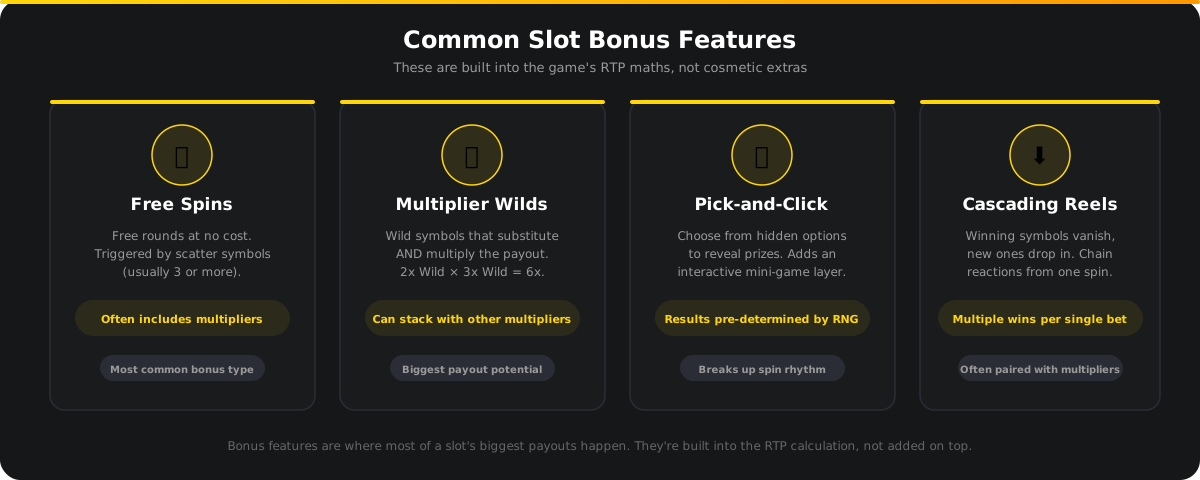
Bonus rounds are what make one slot feel fundamentally different from another. The base game (spinning and matching symbols) is structurally similar across almost all slots. The bonus features are where game designers create variety, and they're often where the biggest payouts happen.
Free Spins are the most common slot bonus rounds. You're awarded a set number of spins at no cost, and any wins during those spins are added to your balance. Free spins are usually triggered by landing a specific number of scatter symbols (typically 3 or more). Many free spin rounds include an extra feature like multipliers, expanding wilds, or additional free spins for landing more scatters during the round.
Multiplier Wilds are wild symbols that not only substitute for other symbols to complete winning combinations, but also multiply the payout. A 2x wild doubles the win. A 3x wild triples it. Some slots stack multipliers: if two wilds with multipliers appear on the same payline, their values multiply together (2x × 3x = 6x).
Pick-and-Click bonuses are interactive mini-games where you select from hidden options (treasure chests, doors, cards) to reveal prizes. They break up the rhythm of spinning and add a moment of player interaction, though the prizes behind each option are predetermined by the RNG.
Cascading Reels (sometimes called tumbling or avalanche reels) replace winning symbols with new ones falling from above, giving you multiple chances to win from a single spin. Each cascade can trigger another win, creating chain reactions that build up payouts without requiring a new bet.
These features aren't cosmetic. They're built into the maths of the game. A slot's RTP calculation includes the expected contribution from bonus rounds, which means the base game RTP is actually lower than the published figure, with the bonus rounds making up the difference. This is why bonus features often produce the biggest wins: the game's maths is designed to concentrate a portion of its return into those moments.
With thousands of online slot machines available on most platforms, choosing one can feel overwhelming. A few filters cut through the noise:
Check the RTP first. Anything above 96% is competitive. Anything below 94% is expensive over time. The difference between a 94% and a 96% RTP slot is significant over hundreds of spins, even though the individual spin experience might feel identical.
Match the volatility to your session goal. If you want a longer session with a steadier balance, look for low slot volatility. If you want the chance of a big win and you're comfortable with long dry stretches, high volatility is where those moments live. Most slots display their volatility rating somewhere in the game info or paytable.
Try the demo first (where available). Many slots offer a free play or demo mode that lets you experience the mechanics, bonus triggers, and pacing without risking real funds. It's the fastest way to figure out whether a game suits your style.
Look at the provider. Different game providers have different design philosophies. Pragmatic Play, Hacksaw Gaming, BGaming, and Pascal each have recognisable styles in terms of volatility, bonus frequency, and visual design. Once you find a provider whose slots you enjoy, exploring their catalogue is a faster path to games you'll like than browsing randomly.
Minibet carries over 3,000 slots from 50+ providers, covering every volatility level, every payline system, and every bonus mechanic covered above. The game lobby is searchable by provider, category, and popularity, so filtering down from thousands to a shortlist is straightforward.
Where slots at Minibet differ from a standard casino is the tournament layer. The crypto slots tournament runs as part of the weekly Slots Circuit, one of five circuits in Minibet's 52-week season. Every week, every spin you play on eligible games contributes to a tournament leaderboard. You're not just playing for individual spin outcomes; you're competing against other players for a share of the weekly prize pool.
This changes the dynamic. In a normal slots session, you're playing against the house. In a tournament, you're playing against other players' accumulated scores, which adds a competitive dimension to a game format that's otherwise purely solo. If that competitive layer appeals to you across multiple game types, the broader online casino games ecosystem at Minibet spans Crash, Live Casino, and Fishing circuits alongside Slots.
How do online slots work for beginners? You choose a bet size, press spin, and the game's random number generator determines where the reels stop. If matching symbols land on a payline (or adjacent reels in ways-to-win slots), you win a payout based on the symbol value and your bet. Slots for beginners is genuinely straightforward: the core mechanic is bet, spin, see what happens.
Are online slot machines rigged? Not at reputable platforms. Online slot machines use independently certified RNG software, and every game's slot RTP is published and testable. The house edge is built into the maths, not hidden manipulation. If a slot says 96% RTP, that's what it returns over time.
What does RTP mean in slots? Slot RTP (Return to Player) is the percentage of all money wagered that the game returns to players over millions of spins. A 96% RTP means a 4% house edge. It's a long-run average, not a per-session guarantee.
What's the difference between paylines and ways-to-win? Paylines are specific patterns across the reels that define a win (e.g. five matching symbols on a diagonal line). Ways-to-win slots remove specific patterns and pay whenever matching symbols appear on adjacent reels from left to right, regardless of row position. More ways means more frequent, smaller wins.
Do slot bonus rounds affect the RTP? Yes. A slot's published RTP includes the expected contribution from its bonus features. The base game RTP on its own is lower, and the bonus rounds are designed to make up the difference. This is why bonus features often produce the biggest payouts.
Does stopping the reels early change the outcome? No. The result is determined by the random number generator the instant you press spin. The reel animation is visual only. Stopping it early just skips the animation; it doesn't change what symbols land.
Gambling should be fun. If it stops feeling that way, help is available. Visit BeGambleAware.org or call the National Gambling Helpline on 0808 8020 133 for free, confidential support. 18+.
This content is for informational purposes only. Betting involves financial risk. Please play responsibly.