
Instant win casino games are a category of online crypto casino games where the result is determined and revealed within seconds of placing your bet. There are no spinning reels to wait for, no dealer to pace the action, and no multi-stage bonus rounds to play through. You make a prediction, set a risk level, or place a bet, and the outcome appears almost immediately. The entire category is built around speed and simplicity.
What makes instant win games interesting beyond that speed is the variety hiding inside the category. "Instant win" isn't a single mechanic. It covers prediction games (guess higher or lower, pick over or under), risk-advance games (how far do you push before cashing out?), number lotteries, wheel spins, and physics-based formats like Plinko. Some have zero decisions. Some have a single decision that shapes every round. This guide covers each type, how the odds work across the category, and why the speed of these fast casino games matters more than most players realise.
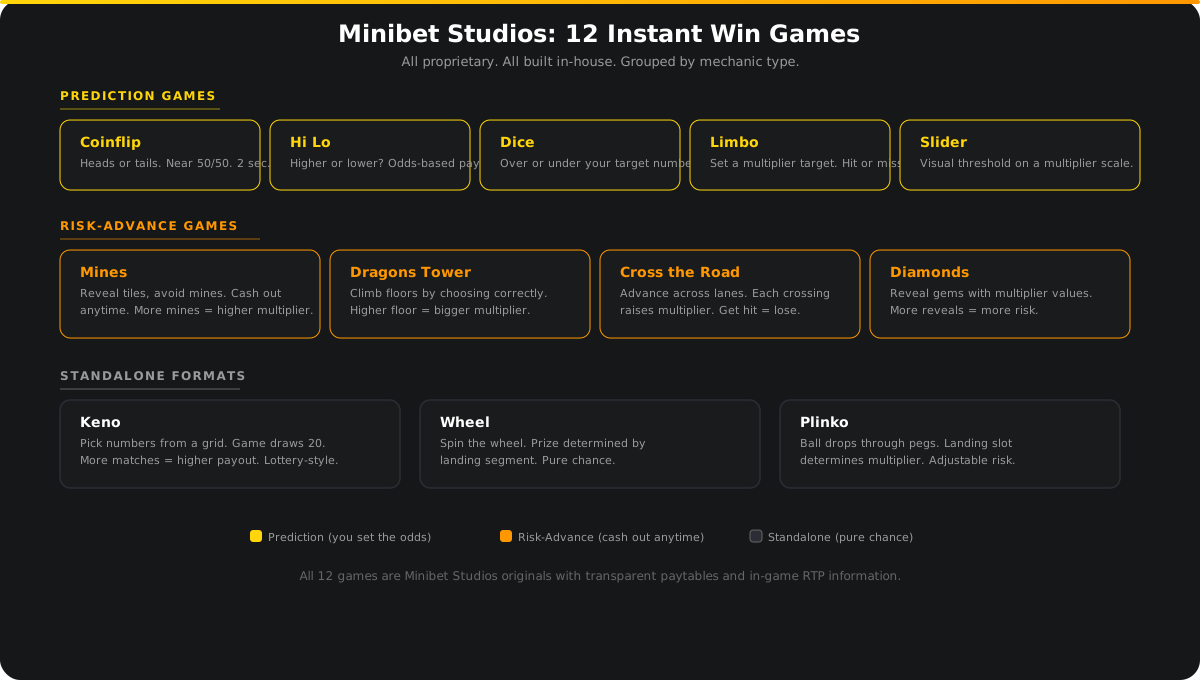
Minibet Studios builds 12 proprietary instant win games in-house. They fall into five distinct categories based on their core mechanic.
1. Prediction Games: Coinflip, Hi Lo, Dice, Limbo, Slider
Prediction games are the purest form of instant win: you make a prediction about an outcome, and the game tells you if you were right.
Coinflip is the simplest version. Two outcomes (heads or tails), near even-money payout, resolved in under two seconds. There's nothing to learn and nothing to analyse. It's the fastest game on the platform and the most transparent in terms of odds: roughly 50/50, minus the house edge.
Hi Lo presents a value and asks you to predict whether the next value will be higher or lower. The payout adjusts based on the probability of your prediction being correct. Predicting a likely outcome (e.g., "higher" when the current value is low) pays less; predicting an unlikely outcome pays more.
Dice works on a similar principle. You set a target number and predict whether the roll will land over or under that target. The further your target is from the extremes, the more likely your prediction and the lower the payout. You're directly setting your own risk-reward ratio with every roll.
Limbo flips the prediction model: you set a multiplier target, and the game generates a random multiplier. If the generated multiplier meets or exceeds your target, you win at that multiplier. Set a low target (1.2x), and you win often but small. Set a high target (10x), and you rarely win, but the payout is large. The mechanic shares DNA with crash games, but without the real-time tension of watching a curve rise.
Slider visualises the prediction as a sliding scale of multiplier values. You choose where to set your threshold, and the game generates a result. If the result lands in your chosen zone, you win the corresponding multiplier. The visual makes the risk-reward trade-off immediately intuitive.
2. Risk-Advance Games: Mines, Dragons Tower, Cross the Road, Diamonds
Risk-advance games add a decision layer that prediction games don't have: how far do you push before cashing out?
Mines is the most well-known format in this category. You're presented with a grid of hidden tiles. Some tiles hide gems (safe), others hide mines (game over). You reveal tiles one at a time, and your multiplier increases with each safe reveal. You can cash out at any point. The more mines you set before the round, the fewer safe tiles there are, which means the multiplier climbs faster, but the chance of hitting a mine is higher.
Mines casino game is effectively a grid-based version of the crash mechanic: you're managing the tension between "take the win now" and "push for a bigger multiplier." The key difference is that in Mines, your choice of which tile to tap is cosmetic (the mine positions are RNG-determined before you start), but the decision of when to stop is real and entirely yours.
Dragons Tower applies the same principle vertically. You climb a tower by choosing one option per floor, with each correct choice advancing you upward and increasing your multiplier. Hit the wrong choice and the round ends. Higher floors mean bigger multipliers but fewer safe options. Cash out at any floor to lock in your current multiplier.
Cross the Road puts the risk-advance mechanic into a lane-crossing format. A character advances across lanes of traffic, and each successful crossing increases your multiplier. Get hit and you lose. Cash out before crossing to lock in your win. The visual framing is playful, but the underlying mechanic is the same as Mines and Dragons Tower: progressive risk with a cash-out decision.
Diamonds reveals gems with multiplier values. The more you reveal, the higher the accumulated payout, but the risk of hitting a losing outcome increases with each reveal. Same cash-out-or-continue dynamic as the others.
3. Number Lottery: Keno
Keno online is a lottery-style format. You select numbers from a grid (typically 1-10 picks from a field of 80), the game draws 20 random numbers, and you're paid based on how many of your picks match. More matches mean higher payouts, and the paytable shifts based on how many numbers you picked.
Picking fewer numbers gives you higher hit frequency but lower maximum payouts. Picking more numbers gives you longer odds but dramatically higher potential prizes if they all hit. The strategy (if you can call it that) is choosing a pick count that matches your risk appetite, similar to choosing a volatility level in slots.
4. Wheel Spin: Wheel
Wheel is a straightforward format: a wheel divided into segments, each carrying a different prize value or multiplier. You bet, the wheel spins, and wherever it stops determines your payout. The odds are visible in the segment distribution. More segments with a given value mean a higher probability of landing there.
The format is pure chance with no decisions. The appeal is visual and tactile: watching the wheel slow down and settle near a high-value segment creates a moment of anticipation that prediction games don't have.
5. Physics-Based: Plinko
Plinko casino drops a ball from the top of a pegged board, and the ball bounces through rows of pegs before landing in one of several slots at the bottom. Each slot carries a different multiplier. The centre slots typically carry lower multipliers (more likely landing zones), while the edge slots carry higher multipliers (less likely).
You can usually adjust the number of peg rows (more rows = more variance in where the ball lands) and the risk level, which changes the multiplier values assigned to each slot. Plinko is satisfying to watch because the physics simulation creates genuine visual unpredictability, even though the final slot is RNG-determined.
Every instant win game operates on the same fundamental principle: the outcome is determined by a random number generator the moment the round starts. In prediction games, the result exists before you make your guess. In risk-advance games like Mines, the mine positions are set before you tap your first tile. In Plinko, the final landing slot is determined before the ball starts bouncing.
The visual elements, the coin spinning, the ball bouncing, the tiles revealing, exist to create an experience around a result that's already been decided. Your "choice" in Mines (which tile to tap) doesn't affect whether it's a mine. The mine positions were assigned before the grid appeared. What does affect the outcome is your decision about when to cash out, which is a genuine strategic choice in every risk-advance game.
This is identical to how slots work (the spin animation is cosmetic; the RNG decides the outcome the instant you press the button). For a deeper dive into how RNG works across casino games, the how online slots work guide covers the same technology in detail.
Instant Win Odds: What You're Actually Paying
The instant win odds across this category vary more widely than in slots because the games are structurally diverse.
Prediction games like Coinflip and Dice have odds you can calculate directly from the game's parameters. In Coinflip, the probability is close to 50% per side, and the payout is slightly below 2x to account for the house edge. In Dice, you set the probability yourself by choosing your target, and the payout adjusts mathematically. The RTP on these games tends to be high (97-99%) because the mechanic is simple and the margin is transparent.
Risk-advance games like Mines have more variable RTPs because your behaviour affects your effective return. Cashing out early on every round gives you a higher effective RTP (you're taking the safe return). Pushing deep into a minefield gives you a lower effective RTP because the probability of hitting a mine compounds with each reveal. The game's theoretical RTP assumes a specific distribution of player behaviour.
Keno online varies by pick count and paytable, typically running 90-95% RTP. Wheel and Plinko depend on the segment/slot distribution and risk level.
You can check any game's RTP through its info or paytable screen before playing. The what is RTP guide explains how to interpret those numbers and why they matter across all casino game formats.
Both categories are RNG-driven, single-player, and available on the same platform. The differences are about pace, complexity, and session structure.
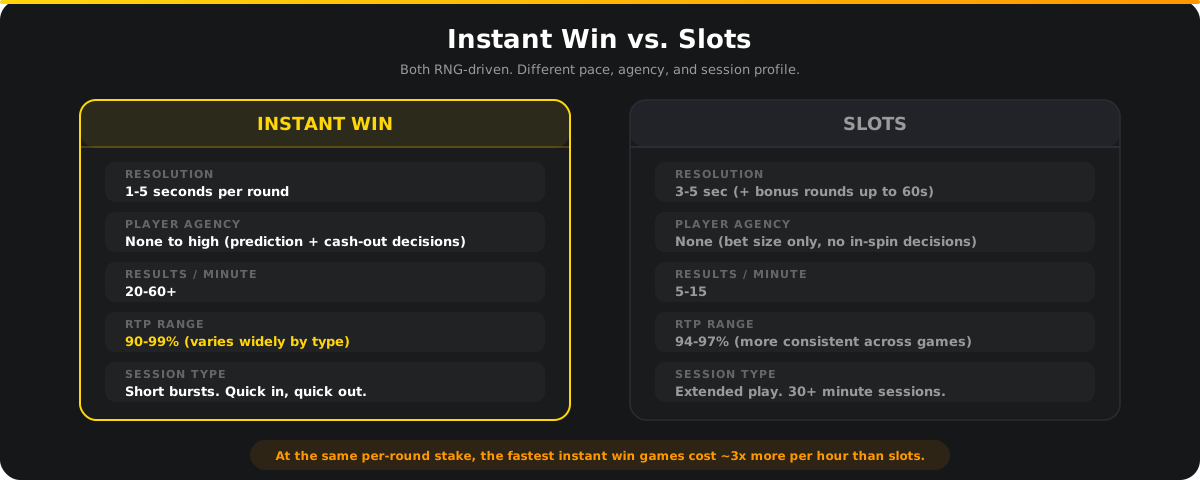
Resolution speed. Instant win games resolve in 1-5 seconds per round. Slots also resolve quickly per spin (3-5 seconds), but bonus rounds, free spins, and cascading sequences can extend a single spin's outcome over 30-60 seconds. Comparing results per minute: instant win games generate 20-60+ outcomes per minute versus 5-15 for slots.
**Player agency. **This is where the categories genuinely diverge. Standard slots have zero decisions during a spin. Instant win games range from zero decisions (Wheel, Plinko, Keno) to one meaningful decision per round (prediction games) to a continuous cash-out decision (risk-advance games like Mines). If you want to feel like your choices matter during the round, risk-advance instant win games offer that. Slots don't.
Complexity. Instant win games are learnable in seconds. There are no paylines, no scatter triggers, no multi-feature bonus rounds. Slots carry layers of mechanics (how online slots work covers this in full) that create depth and variety but also require more learning to understand what's happening on screen.
RTP range. Prediction games often carry higher RTPs (97-99%) than most slots (94-97%). Risk-advance and lottery formats vary more widely. The comparison isn't uniform across the category: a Coinflip at 99% RTP is cheaper to play than most slots, while a keno variant at 90% is more expensive.
Session length. Because instant win games resolve so fast, sessions tend to be shorter. A player might run through 50 rounds in 5 minutes. Slots sessions run longer because the pacing is slower and the bonus rounds create momentum.
The speed of instant win games creates a specific dynamic that deserves honest acknowledgment.
When a game resolves in two seconds and a new round is available immediately, the number of bets you can place per minute is dramatically higher than in any other casino format. A player betting 0.50 USD per round on Coinflip running at 30 rounds per minute is wagering 15 USD per minute, or 900 USD per hour. The same player betting 0.50 USD per spin on a slot at 10 spins per minute is wagering 5 USD per minute, or 300 USD per hour.
The per-round cost looks identical. The per-hour cost is 3x higher purely because of speed.
Risk-advance games like Mines mitigate this somewhat because each round takes longer (you're making multiple tile reveals before cashing out), but the pure prediction games are among the fastest-cycling formats in any casino.
Setting a session budget before you start, and a hard stop when you reach it, matters more here than in slower-paced games. The what is a crash game guide makes a similar point about crash games, which share the same fast-cycle characteristic.
Minibet's instant win category features 12 Minibet Studios originals built in-house: Coinflip, Slider, Dragons Tower, Wheel, Hi Lo, Cross the Road, Limbo, Keno, Plinko, Dice, Diamonds, and Mines. These aren't third-party white-labels. They're proprietary games with transparent paytables and in-game RTP information.
The games are available directly in the browser alongside the full online casino games lobby, with no downloads required. Each game's paytable and rules are accessible through the in-game info screen.
If you enjoy the speed and simplicity of instant win games but want a competitive layer, Minibet's broader tournament ecosystem runs leaderboard-based competition across four game circuits (Crash, Slots, Live Casino, and Fishing) through the crypto casino tournaments system. The competitive format captures the same quick-fire energy in a structured tournament environment.
What are instant win casino games? Instant win casino games are a category where the result is determined and revealed within seconds. Formats include prediction games (Coinflip, Hi Lo, Dice), risk-advance games (Mines, Dragons Tower), number lotteries (Keno), wheel spins, and physics-based games (Plinko). The category is defined by speed and simplicity.
How do instant win games work? Every instant win game uses a random number generator (RNG) that determines the outcome the moment the round starts. In Mines, the mine positions exist before you tap a tile. In Plinko, the landing slot is set before the ball drops. Visual reveals are cosmetic. Your cash-out decision in risk-advance games is real.
What is a mines casino game? Mines presents a grid of hidden tiles. Some are safe (gems), others are mines (game over). You reveal tiles one at a time, and your multiplier increases with each safe reveal. Cash out at any point to lock in your win. More mines on the board means higher multipliers but higher risk. It's similar to crash in that you're managing the tension between taking the safe win and pushing further.
What is plinko casino? Plinko drops a ball from the top of a pegged board. The ball bounces through rows of pegs and lands in one of several slots at the bottom, each carrying a different multiplier. Centre slots pay less (more likely), edge slots pay more (less likely). You can adjust risk level and row count.
Are fast casino games fair? Yes. Instant win games use the same certified RNG technology as slots and table games. The outcomes are independently random and audited. The speed of the game doesn't affect the fairness of individual results.
What's the RTP on instant win games? It varies by type. Prediction games (Coinflip, Dice, Limbo) often run 97-99% RTP. Risk-advance games (Mines, Dragons Tower) have variable effective RTPs depending on your cash-out behaviour. Keno typically runs 90-95%. Check the in-game paytable for the specific figure.
What is an instant play casino? An instant play casino is a platform where games are accessible directly in the browser without downloads or plugins. Most modern online casinos, including Minibet, operate as instant play by default. The term doesn't refer to instant win games specifically, just to the delivery method.
Are instant win games better than slots? Neither is objectively better. Instant win games are faster, often simpler, and some (prediction games) carry higher RTPs than most slots. Slots offer more visual variety, deeper features (bonus rounds, free spins), and longer session pacing. Risk-advance instant win games (Mines, Dragons Tower) offer a unique player-agency element that slots lack entirely.
Gambling should be fun. If it stops feeling that way, help is available. Visit BeGambleAware.org or call the National Gambling Helpline on 0808 8020 133 for free, confidential support. 18+.
This content is for informational purposes only. Betting involves financial risk. Please play responsibly.

-yswxu0.webp)