

Poker is a family of card games where players compete to make the best hand according to a fixed ranking system. That's the one-line version, but it undersells what makes poker genuinely different from every other casino game: in most poker formats, you're not playing against the house. You're playing against other people. The casino takes a small cut (called the rake), but the money you win comes from other players at the table, not from a house edge applied to your bets. This makes poker for beginners simultaneously the most rewarding and the most humbling entry point in casino gaming, because the skill element is real, the learning curve is steep, and the results depend as much on reading situations as they do on the cards you're dealt.
This guide covers the foundation: poker hand rankings (the part you absolutely must memorise), texas holdem rules (the most popular variant by far), how betting rounds work, and the difference between player-vs-player poker and house-banked formats like video poker that you'll find at online casino games platforms like Minibet. If you've already read how to play blackjack, you'll notice a key similarity: both games have a genuine skill component. The difference is that blackjack skill reduces the house edge, while poker skill can give you a positive expected return against weaker opponents.
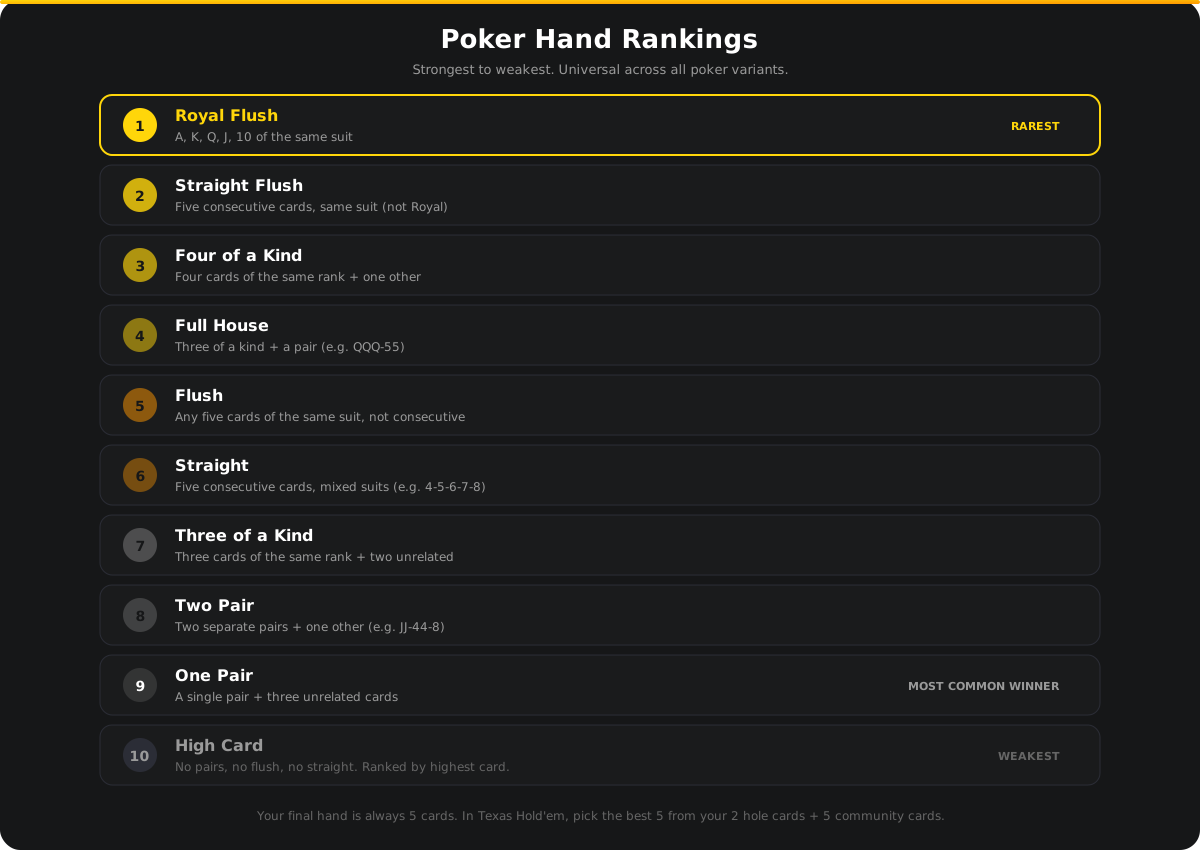
Before anything else, you need the poker hand rankings. These are universal across virtually every poker variant. They rank from strongest to weakest, and they never change regardless of which version of poker you're playing. There are exactly ten ranks:
Royal Flush is the strongest possible hand: A, K, Q, J, 10, all of the same suit. It's the rarest hand in poker and the one everyone dreams of. You might play thousands of hands and never see one.
Straight Flush is five consecutive cards of the same suit that aren't a Royal Flush. For example, 7, 8, 9, 10, J of hearts.
Four of a Kind is four cards of the same rank plus any fifth card. Four Kings, four 7s, etc.
Full House is three of a kind plus a pair. For example, three Queens and two 5s.
Flush is any five cards of the same suit, not in consecutive order. If you hold five hearts, that's a flush regardless of the card values.
Straight is five consecutive cards of mixed suits. For example, 4, 5, 6, 7, 8 across different suits.
Three of a Kind is three cards of the same rank plus two unrelated cards.
Two Pair is exactly what it sounds like: two separate pairs plus a fifth card. For example, two Jacks and two 4s.
One Pair is a single pair plus three unrelated cards. The most common winning hand in Texas Hold'em by a significant margin.
High Card is the weakest hand: no pairs, no flush, no straight, nothing. Your hand is ranked by its highest single card. If nobody at the table has anything better, high card wins, but it rarely holds up.
The key thing to internalise: poker hands are always exactly five cards. In Texas Hold'em, you'll have seven cards available to you (two in your hand plus five on the board), but your final hand is always the best five-card combination you can make from those seven.
Texas Hold'em is the most widely played poker variant in the world, online and offline. If someone says "poker" without specifying a variant, they almost certainly mean Hold'em. Understanding how to play Texas Hold'em covers roughly 80% of what you need to sit down at most poker tables.
Here's how a hand plays out:
The Setup
Each player is dealt two private cards face down. These are your "hole cards," and only you can see them. Five community cards will be dealt face up in the centre of the table over the course of the hand. Your goal is to make the best five-card poker hand using any combination of your two hole cards and the five community cards. You can use both hole cards, one, or even none (playing the board).
Two players post forced bets before the deal: the "small blind" and the "big blind." These rotate around the table each hand, ensuring there's always something in the pot to play for.
The Poker Betting Rounds
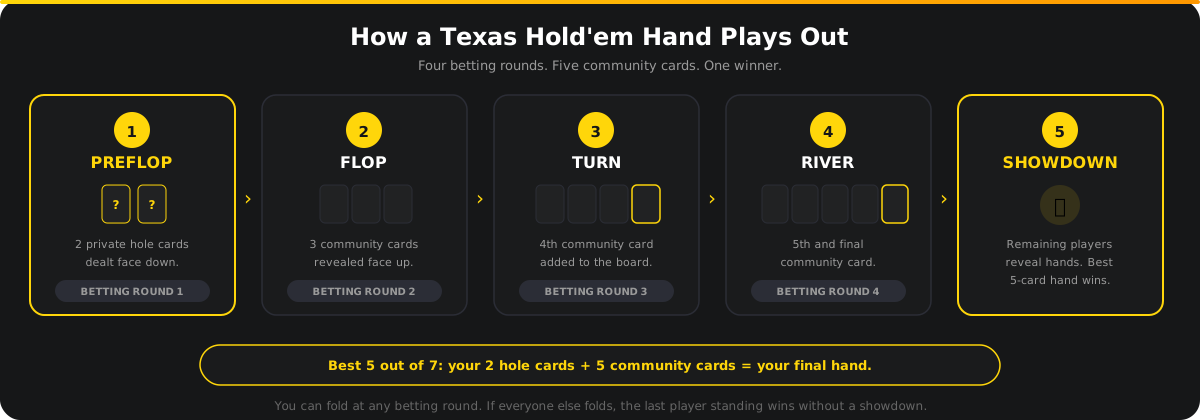
A hand of Texas Hold'em has four poker betting rounds, each tied to a stage of the community card deal:
Preflop. After receiving your two hole cards, the first betting round begins. Starting with the player to the left of the big blind, each player can fold (discard their hand and exit the pot), call (match the big blind), or raise (increase the bet). The action continues around the table until every remaining player has matched the highest bet or folded.
The Flop. Three community cards are dealt face up in the centre. A second betting round follows, starting with the first active player to the left of the dealer. Players can check (pass the action without betting, only available if no bet has been made), bet, call, raise, or fold.
The Turn. A fourth community card is added to the board. Another betting round follows with the same options.
The River. The fifth and final community card is dealt. The last betting round takes place. If two or more players remain after this round, the hand goes to a showdown.
The Showdown
Remaining players reveal their hole cards. The player with the best five-card hand (from any combination of their two hole cards and the five community cards) wins the pot. If two players have the same hand strength, the pot is split.
This is where the opinion-led perspective comes in: poker occupies a unique space in the casino world, and understanding why matters for deciding whether it's the right game for you.
In how to play blackjack, it was noted that basic strategy reduces the house edge. That's true, and it makes blackjack the best game in the casino for players who want to minimise their mathematical disadvantage. But you're still playing against the house, and the house still has an edge no matter what you do.
In player-vs-player poker (like Texas Hold'em cash games or tournaments), there is no house edge on your bets. The house takes a rake (a small percentage of each pot or a fixed fee per hand), but the money in the pot comes from other players and goes to other players. This means that a skilled player can have a positive expected return over time, something that's mathematically impossible in any house-banked game.
The flip side is brutal: if you're the least skilled player at the table, the maths works against you faster than any house edge ever could. Other players don't have a 0.5% edge on you. A significantly better player might be extracting 5%, 10%, or more per hand from weaker opponents. Poker rewards study and experience in a way no other casino game does, but it also punishes overconfidence more harshly.
This is why poker for beginners requires a different mindset than blackjack or roulette. In those games, you're managing a known house edge. In poker, you're managing an unknown skill gap, and the only way to close it is practice, study, and honest self-assessment.
Texas Hold'em dominates the landscape, but a few other variants are worth understanding because you'll encounter them online:
Omaha is structurally similar to Hold'em, but you receive four hole cards instead of two, and you must use exactly two of them (plus three community cards) to make your hand. This creates more possible combinations and more action, which is why Omaha is popular with experienced players who find Hold'em too tight.
Seven Card Stud predates Hold'em as the dominant poker variant. Each player receives seven cards across the hand (some face up, some face down) with no community cards. It's less common online than it used to be, but many platforms still offer it.
Video Poker is a fundamentally different animal. It's a house-banked, single-player game where you're dealt five cards from a virtual deck, choose which to hold, and draw replacements. There are no other players and no bluffing. Your hand is compared against a fixed paytable, and you're paid according to the poker hand rankings. The skill element is real (choosing which cards to hold is a solvable decision with optimal strategy), but the opponent is the paytable, not another person.
Video poker's RTP varies by variant and paytable, but well-chosen video poker games can run as high as 99%+ RTP with optimal play, making them some of the highest-return games in any casino.
Playing too many hands. The single most common beginner mistake. In Texas Hold'em, most starting hands are not worth playing. Beginners tend to see every flop because folding feels like quitting. In reality, folding weak hands preflop is one of the most profitable decisions in poker.
Ignoring position. Where you sit relative to the dealer button dramatically affects which hands are playable and how much information you have when you act. Playing the same hand from early position (first to act, least information) and late position (last to act, most information) is a fundamental error.
Overvaluing one pair. A single pair, even a pair of Aces, is a vulnerable hand in Hold'em. Beginners often commit too many chips with one pair when the board texture suggests an opponent might have two pair, a straight, or a flush.
Bluffing too often. Beginners associate poker with bluffing and try to bluff their way through hands. Against other beginners who call too often (see mistake #1), bluffing is the worst possible strategy. Bluffing works against players who are capable of folding. At beginner tables, many players aren't.
Not managing bankroll. Poker has higher variance than most casino games because the pots can be large relative to the blinds. A proper poker bankroll (for cash games) is typically 20-30 buy-ins for the stake level you're playing. Playing with less means a normal losing streak can wipe you out before the maths has a chance to work in your favour.
Minibet's poker offering centres on video poker, built in-house by Minibet Studios. This is the house-banked, single-player format where your decisions (which cards to hold) directly affect the outcome, but you're playing against a paytable rather than other players. It's an excellent format for learning poker hand rankings in a low-pressure environment, because you see the hands play out quickly and the feedback loop (good hold decisions = better results) is immediate.
Live poker also appears in the live casino tournaments rotation as part of the Live Casino Circuit, in formats like Casino Hold'em and Three Card Poker where you play against the dealer. These are house-banked (the house has an edge), but they use standard poker hands and give you a single strategic decision per hand (fold or play), making them a good bridge between video poker and full player-vs-player formats.
If the competitive element is what draws you to poker, Minibet's broader crypto casino tournament ecosystem spans Crash, Slots, Fishing, Instant Win and Live Casino. The leaderboard format captures the same "beat other players" dynamic that makes poker compelling, applied across different game types.
Is poker for beginners difficult? The rules of Texas Hold'em take 10 minutes to learn. The hand rankings take another 10. Playing well takes much longer, because poker has a genuine skill element that rewards study and experience. But you can sit down and play a correct basic game very quickly.
How do I play Texas Hold'em? You receive two private cards. Five community cards are dealt in stages (flop, turn, river), with a betting round after each stage. You make the best five-card hand from any combination of your cards and the community cards. The best hand at showdown wins the pot.
What's the difference between poker and video poker? Texas Hold'em and other "live" poker formats are player-vs-player: you compete against other people, the house takes a rake, and skill determines long-run results. Video poker is a house-banked, single-player game where you play against a fixed paytable. Both use the same poker hand rankings, but the opponent is fundamentally different.
What are the poker hand rankings in order? From strongest to weakest: Royal Flush, Straight Flush, Four of a Kind, Full House, Flush, Straight, Three of a Kind, Two Pair, One Pair, High Card. These are universal across virtually all poker variants.
Can I make money playing poker? In player-vs-player formats, yes, it's mathematically possible because there's no house edge on the pot (only a rake). But "possible" doesn't mean easy: you need to be more skilled than your opponents consistently, manage your bankroll properly, and handle the variance. In video poker (house-banked), you're playing against a fixed RTP, so long-run profit isn't possible, though some video poker variants have RTPs above 99% with optimal strategy.
What are poker betting rounds? In Texas Hold'em, there are four betting rounds: Preflop (after receiving your hole cards), Flop (after three community cards), Turn (after the fourth community card), and River (after the fifth community card). In each round, players can fold, check, bet, call, or raise.
Should I learn Hold'em or Omaha first? Hold'em. It's simpler (two hole cards vs. four), more widely available online, and has the largest learning community. Omaha is a natural progression once you're comfortable with Hold'em's structure.
Gambling should be fun. If it stops feeling that way, help is available. Visit BeGambleAware.org or call the National Gambling Helpline on 0808 8020 133 for free, confidential support. 18+.
This content is for informational purposes only. Betting involves financial risk. Please play responsibly.


-yswxu0.webp)