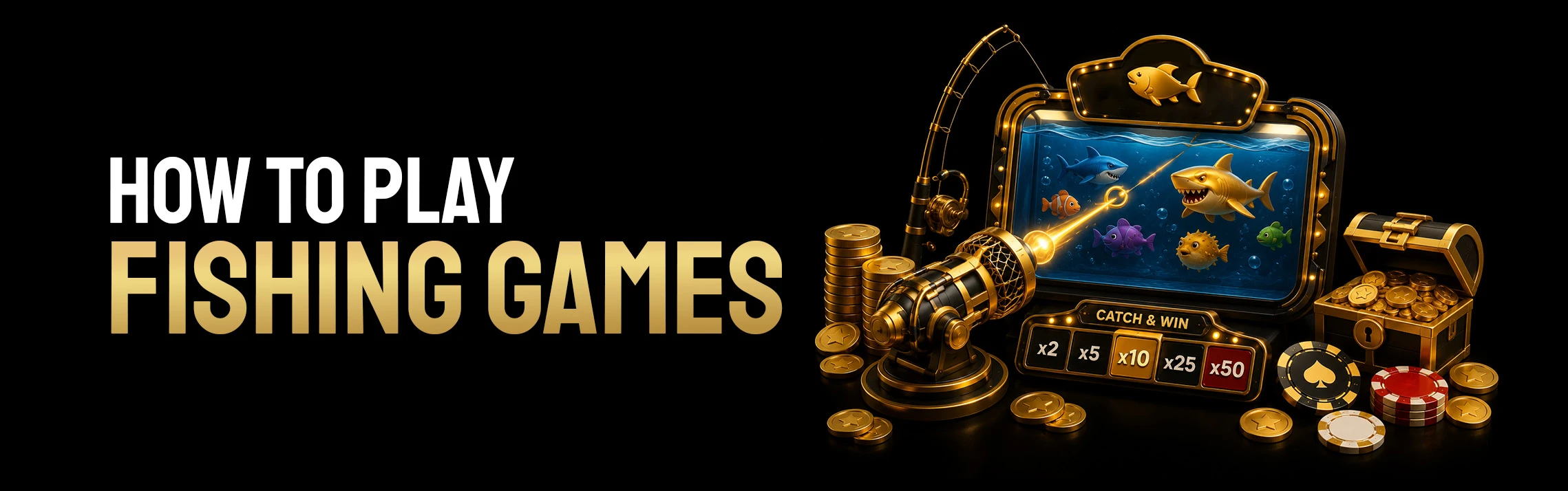
A fishing casino game is an arcade-style casino format where you aim and shoot at fish swimming across your screen, and each fish you catch pays out a multiplier of your bet. It looks like a video game. It feels like a video game. But the payout mechanic underneath it is a casino game: you're spending ammunition (which costs real money), and the fish you hit return a multiplier of what you spent to catch them. Some fish are small and pay 2x. Some are large and pay 50x or more. Some escape no matter how many shots you fire.
If you've never encountered a fish game online casino format before, the concept probably sounds strange sitting next to blackjack and roulette in a list of online casino games. But fishing games have been one of the fastest-growing casino categories globally, particularly across Asian markets and crypto casinos, because they offer something no other casino format does: active, continuous gameplay where you're making decisions every second, not waiting for a result to be handed to you.
This guide covers how the mechanic actually works, what the odds look like, whether the "skill" element is real, and why the format sits in a genuinely different space from slots, table games, or instant win formats.
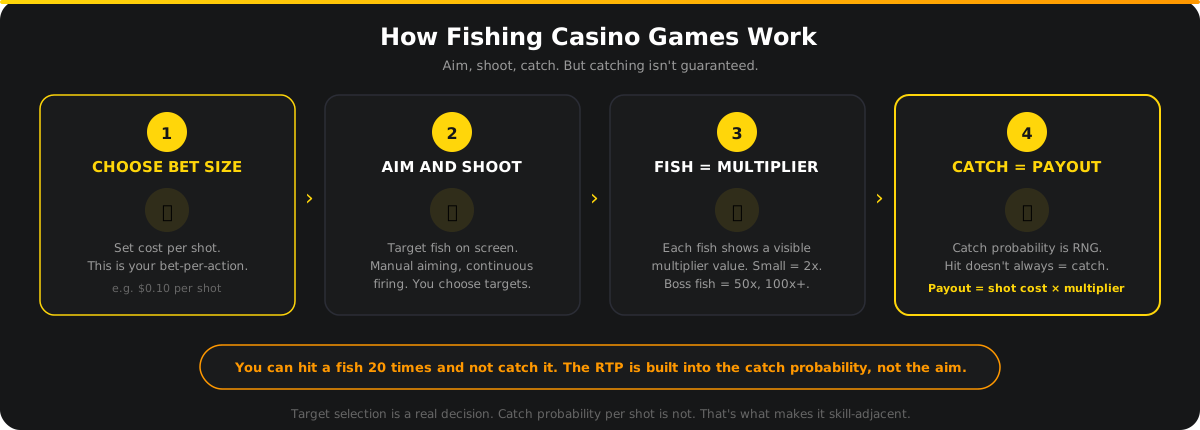
The core loop of every fish shooting game is the same across providers:
Step 1: Choose your bet size (ammunition cost). Before you start shooting, you set the cost per shot. Each bullet or projectile costs a fixed amount, and this is your effective "bet per action." A shot costing $0.10 means every time you fire, you spend $0.10 from your balance. Unlike slots where you set a bet per spin and then wait, in fishing games you're firing continuously and the cost accumulates in real time.
Step 2: Aim and shoot. Fish of various types, sizes, and speeds swim across the screen. You aim your weapon and fire at them. Some fish move slowly and are easy targets. Some dart across the screen. Some are massive "boss" fish that take many shots to catch. The aiming is manual: you point, you shoot, you decide which fish to target.
Step 3: Each fish carries a fishing game multiplier. Every fish on screen has an assigned multiplier value, usually visible on or near the fish. A small common fish might carry a 2x multiplier. A medium fish might carry 10x. A rare boss fish might carry 50x, 100x, or higher. The multiplier determines what you win if you catch that fish: your shot cost multiplied by the fish's value.
Step 4: Catching isn't guaranteed. This is the crucial mechanic. Hitting a fish doesn't mean you catch it. Each fish has a hidden catch probability determined by the RNG. You might hit a 50x boss fish with 20 shots ($2.00 spent) and not catch it. You might hit it once and catch it immediately. The number of shots required to catch any given fish is random, and the fishing game RTP is built into the relationship between the cost of ammunition and the probability-weighted value of catches over time.
This is the most important question in fishing game casino design, and the honest answer is: partially, but not in the way most players think.
What IS skill-based: which fish you choose to target. Aiming at a 2x fish that costs you one shot is a different economic decision than aiming at a 50x fish that might cost you 30 shots before it's caught (or escapes). Choosing to ignore a fast-moving fish that's hard to hit and focus on a slower one with a similar multiplier is a resource-allocation decision. Managing your ammunition budget across a session rather than emptying it on a single boss fish is a bankroll management decision.
What is NOT skill-based: whether a specific shot catches a specific fish. The catch probability per hit is determined by the RNG, not by your aim accuracy. You can't "aim better" to increase your catch rate. The crosshair is a targeting tool that determines which fish your shot is applied to, but the probability of that shot resulting in a catch is predetermined. A pixel-perfect shot and a barely-connecting shot have the same catch probability.
This makes fishing games "skill-adjacent" rather than truly skill-based. The decisions you make about target selection and ammunition management genuinely affect your expected return, but the outcome of each individual shot is RNG-determined. It's a meaningful distinction: you have more agency than in slots (where you press spin and wait), but less than in poker (where your decisions directly determine whether you win the pot).
For players coming from other formats, the closest comparison is the cash-out decision in crash games. In a fish shooting game, your continuous decisions about where to invest your shots create a similar tension between "keep shooting at this high-value fish" and "cut my losses and move to an easier target." The "What is RTP?" concept applies here the same way it does everywhere: the game's maths defines the long-run return, and your decisions operate within that framework.
The fishing game RTP calculation is less transparent than in slots or table games because the return isn't tied to a single discrete event. In a slot, each spin is independent and the RTP applies cleanly per spin. In a fishing game, your "bet" is distributed across many shots, many fish, and many catches (or misses) over the course of a session, which makes the per-action RTP harder to intuit.
Here's the simplified version: the game is designed so that, over many sessions across all players, the total value of fish caught equals a specific percentage of the total ammunition spent. If the fishing game RTP is 96%, then for every $100 worth of shots fired across all players, $96 is returned as fish catches and $4 goes to the house.
What makes it feel different from slots is that the variance happens at the fish level, not the spin level. You might spend $5 on shots at a boss fish and catch nothing. Then one shot on a small fish returns $0.50. Then a single hit on a medium fish catches at 20x and returns $2.00. The per-shot outcomes are wildly variable, but over the session they converge toward the published RTP.
Checking the fishing game RTP before playing is the same advice that applies to every casino game: it tells you what the game costs over time. Most fishing games from major providers run between 94% and 97% RTP, which is competitive with mainstream slots. The how online slots work guide covers the RTP concept in full if you want to understand the mechanic across both formats.
Four things separate the fishing game casino experience from every other format on the platform:
Active, continuous gameplay. In slots, you press spin and watch. In blackjack, you make a decision every 30 seconds. In fishing, you're making targeting decisions every second. The game doesn't pause. Fish keep swimming. You keep shooting. The engagement model is closer to a video game than a traditional casino game.
Visible multiplier values. Every fish on screen shows you what it's worth. You can see the 50x boss fish swimming past the 2x small fish and make a conscious decision about which to target. This visibility creates a strategic layer that slots (where you can't see the value of the next spin before it happens) don't have.
Multiplayer rooms. Most fish table game formats are multiplayer by default. Multiple players shoot at the same fish in the same room simultaneously. If you catch a fish, it's yours, even if other players were also shooting at it. This creates a competitive dynamic that's social in a way slots aren't, similar to the shared experience of watching other players' bets in crash games.
Session pacing you control. In slots, the game dictates the pace (spin, wait, spin). In fishing games, you dictate the pace. You can fire rapidly and burn through your budget fast, or you can wait, be selective, and stretch a session. The pacing is entirely in your hands, which gives the format a different rhythm from any other casino category.
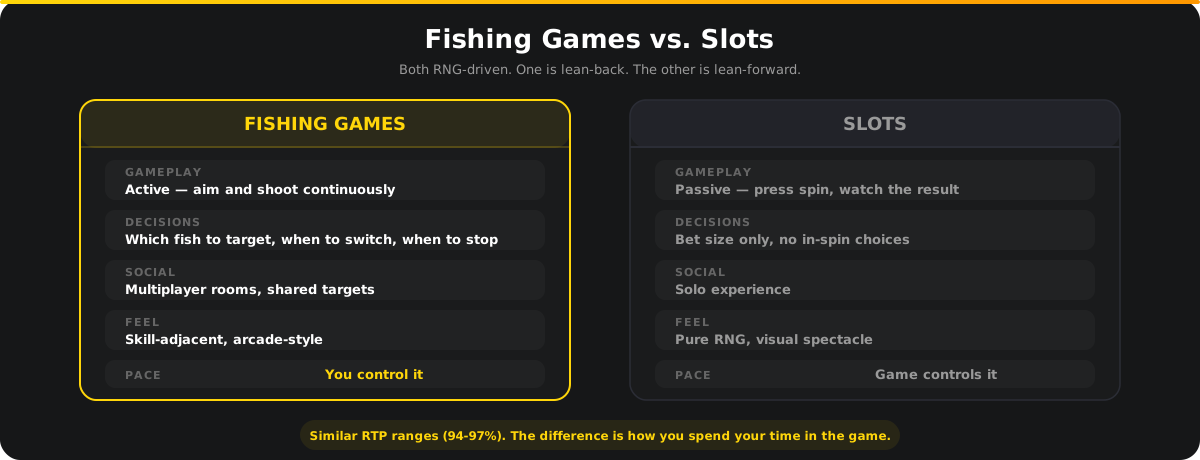
Both are RNG-driven and available on the same platform, but the experience is fundamentally different.
Player agency. Slots: zero decisions during a spin. Fishing: continuous targeting decisions every second. This is the biggest practical difference. If you want to feel like your choices matter during the game, fishing delivers that in a way slots structurally can't.
Engagement model. Slots are designed for lean-back play. You spin, you watch, you spin again. Fishing games are lean-forward. You're constantly aiming, shooting, switching targets, and managing your ammunition budget.
Cost structure. In slots, your bet is per spin, and each spin is a discrete event. In fishing, your cost is per shot, and the shots accumulate continuously. This makes it harder to track your spend intuitively, which is why setting a session budget before you start is especially important.
RTP. Similar ranges. Most fishing games run 94-97% RTP, roughly in line with mainstream slots. The cost of playing over time is comparable between the two categories.
Visual style. Fishing games are colourful, animated, arcade-style experiences. The aesthetic is closer to a mobile game than a traditional casino. If the standard casino visual language (reels, cards, felt tables) doesn't appeal to you, fishing games offer a completely different visual world.
Minibet carries fishing games from third-party providers as a dedicated game category, and the format has its own circuit in the tournament system. The fishing casino tournament runs as part of the weekly Fishing Circuit, one of four circuits in Minibet's 52-week season. During fishing weeks, your sessions contribute to a tournament leaderboard alongside other players.
The tournament format adds a layer to the fishing experience that standard play doesn't have. In a normal fishing session, you're playing against the game's maths: catch enough fish at high enough multipliers to beat the house edge. In a tournament, your accumulated catches are ranked against other players for a share of a weekly prize pool, which changes how you think about target selection. Do you play conservatively and aim for consistent small catches, or do you target boss fish with massive multipliers that could catapult you up the leaderboard?
This competitive dimension ties fishing into Minibet's broader crypto casino tournaments ecosystem, where the same leaderboard format spans Crash, Slots, Live Casino, and Fishing across a full 52-week season.
What is a fishing casino game? A fishing casino game is an arcade-style format where you aim and shoot at fish swimming on screen. Each fish carries a multiplier value, and catching one pays out your shot cost times the fish's multiplier. The aiming is manual, but catch probability is RNG-determined.
How do fish shooting games work? You set a cost per shot (your bet per action), aim at fish on screen, and fire. Each hit has an RNG-determined probability of catching the fish. If you catch it, you're paid your shot cost multiplied by the fish's visible multiplier value. If you don't catch it, the shot cost is lost.
Are fishing games skill-based? Partially. Which fish you target and how you manage your ammunition budget are genuine skill decisions that affect your expected return. But whether a specific shot catches a specific fish is RNG-determined, not based on aim accuracy. The format is skill-adjacent rather than fully skill-based.
What is a fish table game? "Fish table game" is the original name for the format, which started as physical arcade cabinets (a large table-mounted screen with mounted guns for multiple players). The online fish table game is the digital version of the same mechanic, played on your device rather than a physical table.
What is the RTP on fishing games? Most fishing games run between 94% and 97% RTP, which is competitive with mainstream slots. The RTP is built into the relationship between ammunition cost and catch probability across all fish types. Check the specific game's info screen for the exact figure.
How do fishing games compare to slots? Fishing games offer active, continuous gameplay with targeting decisions every second. Slots are passive (press spin, watch). Both use RNG and have similar RTP ranges. The key difference is player agency: fishing gives you control over targeting and pacing that slots don't.
Can I play fishing games in tournaments? Yes. Minibet runs a weekly Fishing Circuit as part of its 52-week tournament season. Your fishing sessions contribute to a leaderboard, and accumulated catches are ranked against other players for a weekly prize pool.
Why are fishing games popular in crypto casinos? The format appeals to a younger, digital-native audience that grew up with arcade and mobile games. The active gameplay and multiplayer rooms create an engagement model that feels more like gaming than traditional casino play, which aligns well with the crypto casino demographic.
Gambling should be fun. If it stops feeling that way, help is available. Visit BeGambleAware.org or call the National Gambling Helpline on 0808 8020 133 for free, confidential support. 18+.
This content is for informational purposes only. Betting involves financial risk. Please play responsibly.