Roulette is a casino game where a ball is spun around a numbered wheel, and players bet on where it will land. That's the whole concept. There are no cards to count, no opponents to read, and no complex decision trees to memorise. You place your chips on the outcome you're predicting, the wheel spins, and the result is entirely down to physics and chance. This guide breaks down the roulette rules, the roulette wheel layout, every roulette bet type, and the difference between the two main variants, so that anyone coming to this as roulette for beginners can sit down and play with confidence rather than confusion.
If you've already covered how to play blackjack, you'll notice a key difference: blackjack has a strategy layer where your decisions directly affect the outcome. Roulette doesn't. Every bet has a fixed house edge, and no decision you make changes it. What you're choosing is your risk profile, not your odds.
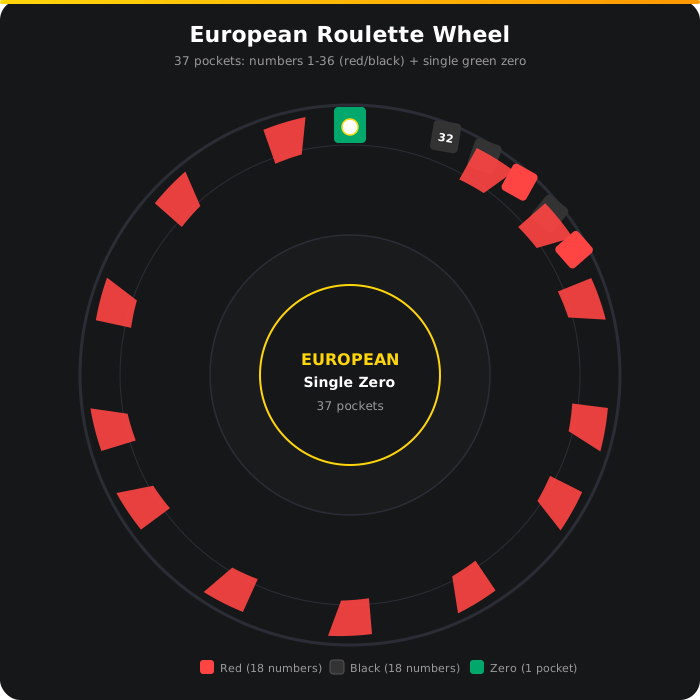
The roulette wheel layout is the first thing to understand because it determines everything else. A European roulette wheel has 37 pockets: numbers 1 through 36, alternating between red and black, plus a single green zero (0). The numbers aren't arranged in sequential order around the wheel. They're distributed to balance the maths: high and low numbers, red and black, odd and even are all spread as evenly as possible around the circumference.
The table layout is separate from the wheel. It's the felt surface where you place your bets, and it's arranged as a grid: numbers 1-36 in three columns of twelve rows, with the zero at the top. Surrounding the number grid are the "outside" betting areas for broader bets like red/black, odd/even, and high/low. The grid is where you'll place all your bets, and the different positions on the grid correspond to different bet types with different roulette payouts.
A round of roulette follows a simple, consistent sequence:
The betting window opens. The dealer (or software, in RNG roulette) announces that bets are open. You place your chips on the table layout in the positions corresponding to your predictions.
The wheel is spun. The dealer spins the wheel in one direction and releases the ball in the opposite direction. In live dealer roulette, this is a real physical wheel with a real ball. In RNG roulette, the outcome is determined by a random number generator the moment the round starts.
Bets close. The dealer calls "no more bets" once the ball begins to slow. Any chips placed after this point don't count.
The ball lands. The ball settles into one of the 37 (or 38, in American roulette) numbered pockets. The winning number is announced, and a marker is placed on the table to identify it.
Payouts are made. Winning bets are paid according to their bet type. Losing bets are cleared from the table. A new round begins.
The entire cycle takes roughly 60 to 90 seconds in live dealer games, making roulette one of the more relaxed-paced table games compared to something like live casino tournaments in blackjack, where every hand requires active decisions.
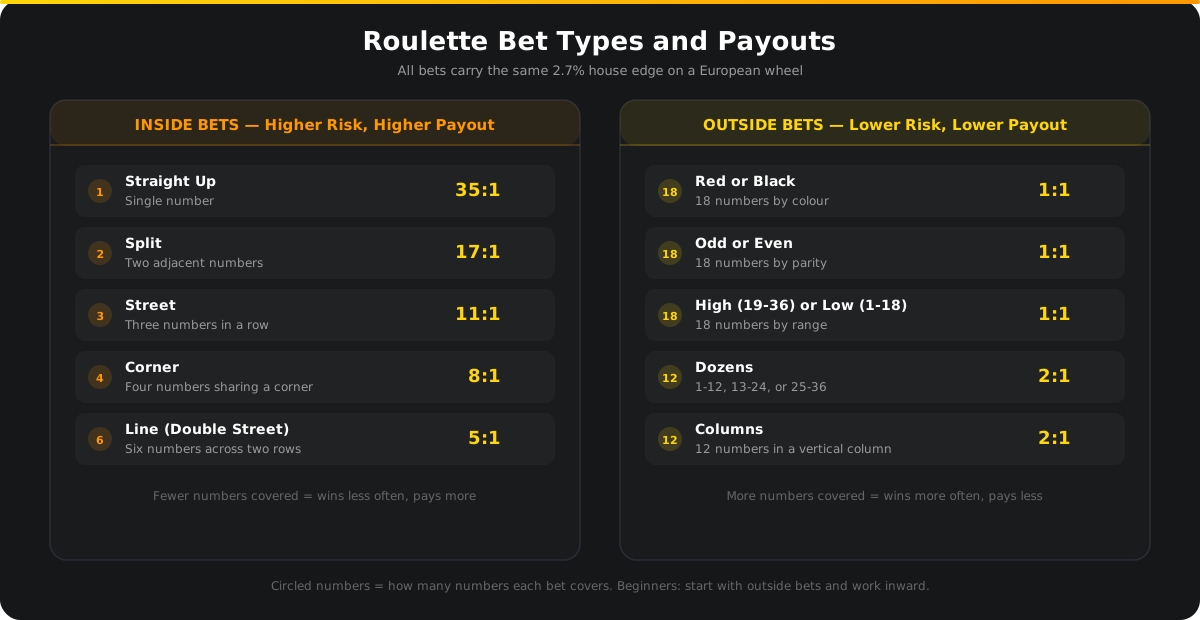
Every bet in roulette falls into one of two categories: inside bets (placed on specific numbers or small groups of numbers within the grid) and outside bets (placed on broader categories in the areas surrounding the grid). The distinction matters because it determines both the risk and the roulette payouts.
Inside Bets
Inside bets cover fewer numbers, which means lower probability but higher payouts:
Straight Up is a bet on a single number. You place your chip directly on one number. Payout: 35 to 1. Probability on a European wheel: 2.7% (1 in 37).
**Split **covers two adjacent numbers. Place your chip on the line between two numbers. Payout: 17 to 1.
Street covers three numbers in a horizontal row. Place your chip on the outer edge of the row. Payout: 11 to 1.
**Corner **(or Square) covers four numbers that share a corner. Place your chip at the intersection point. Payout: 8 to 1.
Line (or Double Street) covers six numbers across two adjacent rows. Payout: 5 to 1.
Outside Bets
Outside bets cover larger groups of numbers, meaning higher probability but smaller payouts:
Red or Black is a bet on colour. Covers 18 numbers. Payout: 1 to 1 (even money).
Odd or Even covers all odd or all even numbers (excluding zero). 18 numbers. Payout: 1 to 1.
High (19-36) or Low (1-18) covers half the non-zero numbers. Payout: 1 to 1.
Dozens covers 12 numbers in a block (1-12, 13-24, or 25-36). Payout: 2 to 1.
**Columns **covers 12 numbers in one vertical column of the grid. Payout: 2 to 1.
For roulette for beginners, outside bets are the natural starting point. They win more often (close to 50/50 on even-money bets), the payouts are easier to track, and they give you a feel for how the game flows before you start experimenting with inside bets.
Every payout in roulette follows a simple formula: the payout equals (36 ÷ numbers covered) minus 1. A straight-up bet covers 1 number, so the payout is (36 ÷ 1) - 1 = 35 to 1. A dozens bet covers 12 numbers, so the payout is (36 ÷ 12) - 1 = 2 to 1.
The key insight is that the payout formula uses 36 as the base, but the wheel has 37 pockets (in European roulette). That single green zero is where the roulette house edge lives. If there were no zero, the payouts would exactly match the true odds and the game would be mathematically fair. The zero tips the balance in the house's favour on every single bet, regardless of which type you choose.
On a European wheel, the house edge is 2.7% across all standard bets. That means for every 100 MBUSD wagered over time, you'd expect to lose roughly 2.70 MBUSD on average. This applies equally to a straight-up bet at 35:1 and a red/black bet at 1:1. The risk profile is different (volatile vs. steady), but the mathematical edge is identical.
Understanding this matters because it exposes one of the biggest misconceptions in roulette: the idea that certain bets are "smarter" than others. From a pure maths perspective, every standard bet on a European wheel has the same house edge. The choice between inside and outside bets is about volatility preference, not mathematical advantage. If you want to understand how this compares to other games, the what is RTP guide explains the concept in more depth.
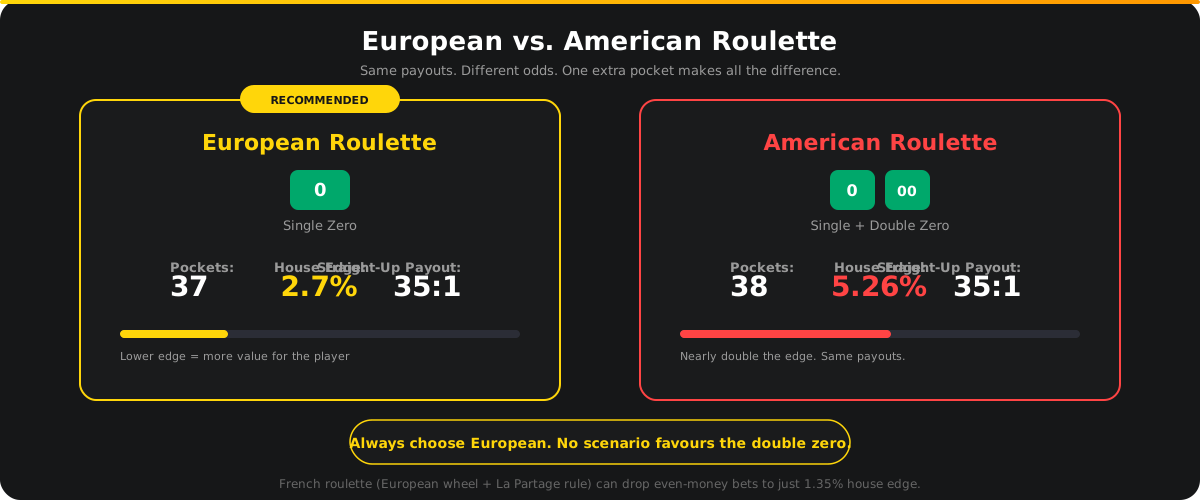
The difference between the two main variants is straightforward and significant:
**European **roulette has 37 pockets: numbers 1-36 plus a single zero (0). The roulette house edge is between 2-4%.
American roulette has 38 pockets: numbers 1-36, a single zero (0), and a double zero (00). The house is between 3-5%.
The payouts don't change between the two variants. A straight-up bet still pays 35:1 in both versions. But the extra pocket means the true odds of hitting any given number are slightly less (1 in 38 instead of 1 in 37), while the payout stays calibrated to a 36-number game.
Some casinos also offer French roulette, which uses the European wheel but adds two player-friendly rules: "La Partage" (you get half your even-money bet back if the ball lands on zero) and "En Prison" (your even-money bet stays locked for the next spin if zero hits). These rules can reduce the house edge on even-money bets to as low as 1.35%.
"The Martingale system beats the house." The Martingale (doubling your bet after every loss) doesn't change the house edge. It changes the distribution of outcomes: you win small amounts frequently and lose catastrophically when you hit a long streak, which you eventually will. Every table has a maximum bet limit, which is specifically there to cap this strategy. The maths is settled on this one.
**"A number is 'due' after a long absence." **Every spin is independent. The wheel has no memory. If red has come up ten times in a row, the probability of red on the next spin is exactly the same as it was before the streak started. This is called the gambler's fallacy, and it's responsible for more roulette losses than any other misconception.
"Dealers can control where the ball lands." On a properly maintained wheel, the result is determined by physics: the speed of the spin, the velocity of the ball, the point of release, and countless micro-variables. No human can control these with the precision needed to target a specific pocket.
"Certain bets are 'smarter' than others." On a standard European wheel, every bet carries a 2.7% house edge. Red/black isn't "safer" than a straight-up bet in terms of the mathematical edge. It's steadier in terms of session experience, but the long-run cost is identical.
Minibet offers live dealer roulette streamed from professional studios, with a real wheel, a real dealer, and real-time interaction. The betting interface overlays on top of the video stream, so you place your chips exactly as you would at a physical table, just by tapping or clicking instead of reaching. European roulette variants are available, which means you're playing on the lower 2.7% house edge covered above.
Roulette is part of the Live Casino Circuit rotation within the live casino tournaments system at Minibet. During roulette weeks, your sessions contribute to a weekly leaderboard alongside other players. It's the same game with the same rules, but with a competitive layer that turns an individual experience into a shared one. If tournament formats appeal to you across different online crypto casino games, the broader Minibet Circuit spans Crash, Slots, Fishing, and Live Casino across a full 52-week season.
Is roulette for beginners easy to learn? Roulette is one of the easiest casino games to learn. There are no decisions that affect the outcome, no strategy tables to memorise, and no interaction with other players. You bet, the wheel spins, and you either win or don't. The only learning curve is understanding the different bet types and what each one covers.
What is the roulette house edge? On a European wheel (single zero), the house edge is 2.7% on all standard bets. On an American wheel (double zero), it's 5.26%. French roulette with La Partage can drop the edge to 1.35% on even-money bets.
Which roulette bets have the best odds? From a pure house-edge perspective, all standard bets on a European wheel are equal at 2.7%. The difference is in volatility: outside bets (red/black, odd/even) win more often but pay less, while inside bets (straight-up, split) win rarely but pay significantly more.
Should I play European or American roulette? European, always. The house edge is nearly half (2.7% vs. 5.26%), and the payouts are identical between the two variants. There is no mathematical scenario where American roulette benefits the player over European.
Do roulette strategies work? No betting system changes the house edge. The Martingale, Fibonacci, D'Alembert, and every other system redistribute when you win and lose, but the long-run expected cost is the same. The house edge is built into the wheel, not the bet pattern.
What's the difference between inside and outside bets? Inside bets cover fewer numbers with higher payouts (e.g. straight-up: 1 number at 35:1). Outside bets cover more numbers with lower payouts (e.g. red/black: 18 numbers at 1:1). Both carry the same house edge on a European wheel.
Gambling should be fun. If it stops feeling that way, help is available. Visit BeGambleAware.org or call the National Gambling Helpline on 0808 8020 133 for free, confidential support. 18+.
This content is for informational purposes only. Betting involves financial risk. Please play responsibly.