-desktop-image-8kko49.webp)
-mobile-image-z17i0i.webp)
Baccarat is a card game where two hands are dealt (the "Player" hand and the "Banker" hand) and you bet on which one will finish closer to a value of 9. That's it. You don't play either hand yourself. You don't make decisions during the round. You don't choose whether to hit or stand. The baccarat rules are entirely mechanical: once the cards are dealt, a fixed set of drawing rules determines whether a third card is added, and the hand closest to 9 wins. Your only job is choosing what to bet on before the deal.
This makes baccarat paradoxically intimidating and simple. The table looks complex, the terminology sounds foreign (punto, banco, le grande), and the third card rule looks like it needs a mathematics degree. But in practice, you can walk up to a table and play correctly within two minutes because the game makes every decision for you. This guide covers the full baccarat rules for beginners, from card values to the third card drawing rule, so you understand what's happening rather than just watching it happen.
If you're coming from how to play blackjack, the biggest adjustment is this: in blackjack, your decisions directly affect the outcome. In baccarat, they don't. Baccarat is closer to how to play roulette in that sense: you choose your bet, and then the game plays itself.
Baccarat card values work differently from every other card game, and the system is the first thing to learn because everything else builds on it.
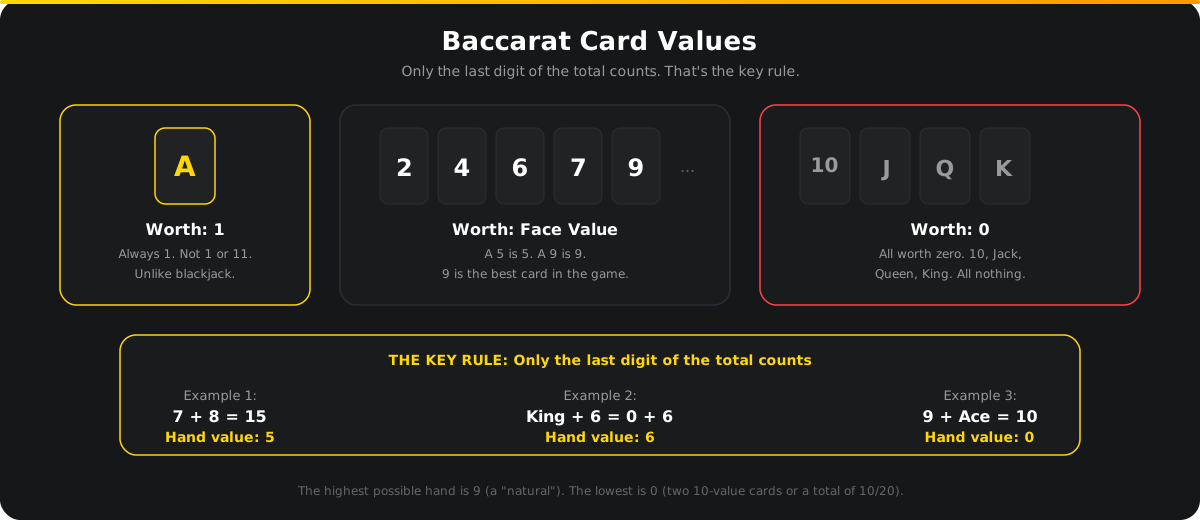
Aces are worth 1. Not 1 or 11 like in blackjack. Always 1.
Numbered cards (2 through 9) are worth their face value. A 5 is worth 5. A 9 is worth 9. Straightforward.
10s and face cards (Jack, Queen, King) are all worth 0. This is the part that throws people. In blackjack, a face card is your best friend. In baccarat, it's worth nothing.
The critical rule that makes baccarat maths unique: only the last digit of the total counts. If the two cards in a hand add up to 15, the hand value is 5 (drop the tens digit). If they add up to 12, the hand value is 2. If they add up to 9, the hand value is 9. The highest possible hand value is 9, and the lowest is 0 (a hand of two 10-value cards).
This is why baccarat for beginners is simpler than it looks. You never need to add past single digits. A hand of 7 and 8 gives you 15, which means a hand value of 5. A hand of 4 and 3 gives you 7. A hand of King and 6 gives you 6 (0 + 6). Once you internalise the "last digit only" rule, you can read any hand instantly.
Every round of baccarat follows the same fixed sequence. No variation, no player choice during the round, no exceptions. Here's the step-by-step:
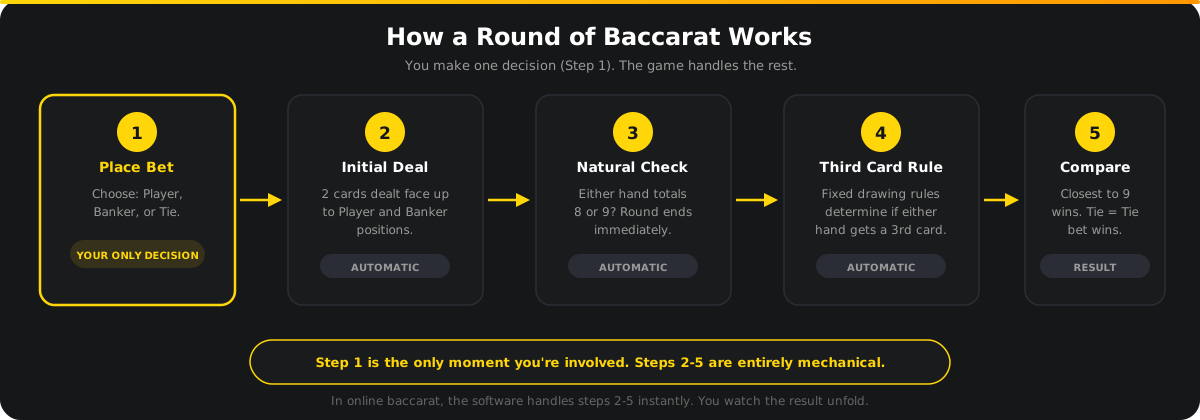
Step 1: Place your bet. Before any cards are dealt, you choose one of three bets: Player, Banker, or Tie. Your chips go on the corresponding area of the table. This is your only decision in the entire round.
Step 2: The initial deal. The dealer deals two cards face up to both the Player position and the Banker position. These are not your cards and the dealer's cards. "Player" and "Banker" are just the names of the two hands. You can bet on either one regardless of which side of the table you're sitting on.
Step 3: Check for a "Natural." If either hand totals 8 or 9 from the initial two cards, that's called a "natural" and the round ends immediately. A natural 9 beats a natural 8. If both sides have the same natural, it's a tie. No third card is drawn when a natural appears.
Step 4: The third card rule applies (if needed). If neither hand has a natural, a fixed set of drawing rules determines whether the Player hand, the Banker hand, or both receive a third card. These rules are entirely automatic. The dealer follows them mechanically, and in online baccarat the software handles them instantly. You don't need to memorise them to play, but understanding them helps you see why the game unfolds the way it does.
Step 5: Compare hands. After any third cards are drawn, the hand closest to 9 wins. If you bet on that hand, you're paid according to the bet type. If both hands are equal, the Tie bet wins and the other two bets push (your stake is returned).
The three betting options in baccarat look simple on the surface, but they carry very different house edges. Understanding the difference is the single most important piece of baccarat strategy.
The Player Bet
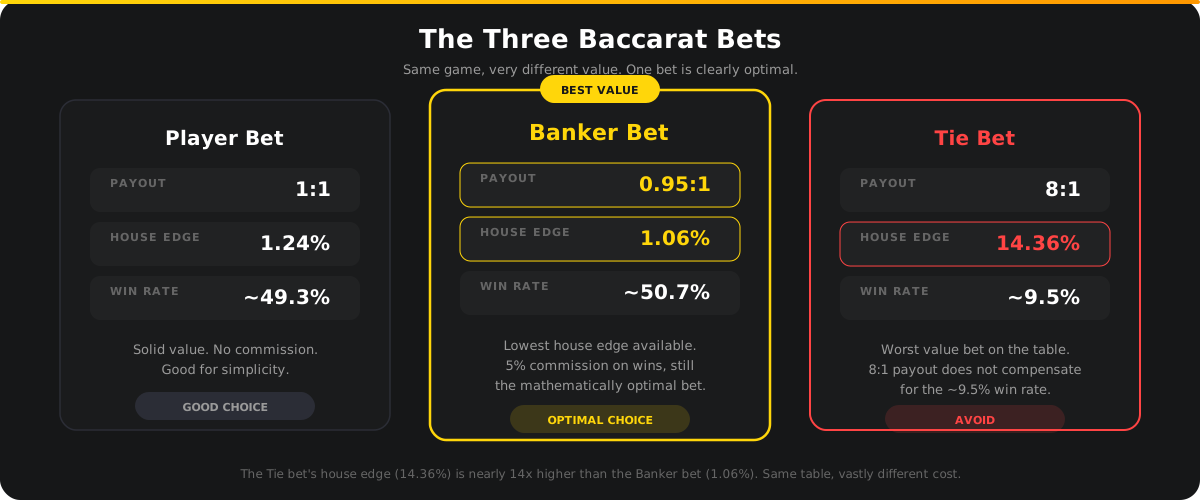
Betting on Player means you're wagering that the Player hand will finish closer to 9 than the Banker hand. If the Player hand wins, you receive a 1:1 payout (you get back your stake plus an equal amount in winnings).
The baccarat house edge on the Player bet is 1.24%. That's already very low compared to most casino games. For context, a standard European roulette bet carries a 2.7% house edge, so the Player bet in baccarat gives you roughly twice the value per unit wagered.
The Banker Bet
Betting on Banker means you're wagering that the Banker hand will finish closer to 9. The Banker bet wins slightly more often than the Player bet (roughly 50.68% of the time vs. 49.32% for Player, excluding ties), which is why the casino charges a 5% commission on Banker wins. After commission, your effective payout is 0.95:1 rather than a full 1:1.
Even after that commission, the baccarat house edge on the Banker bet is 1.06%, which is the lowest of the three options and one of the lowest house edges in any casino game. This is why you'll often hear that the Banker bet is the "correct" bet in baccarat: it gives you the best mathematical return over time, period. It's not a guarantee of winning any specific hand, but it costs you the least over hundreds of hands.
The Tie Bet
Betting on Tie means you're wagering that both hands will finish with the same total. The payout is typically 8:1 (some tables offer 9:1), which looks attractive. The baccarat house edge on the Tie bet is 14.36%.
That's not a typo. The Tie bet costs you roughly 13 times more per unit wagered than the Banker bet. It wins approximately once every 10-11 hands, which feels rare enough to be exciting when it hits, but the 8:1 payout doesn't come close to compensating for how infrequently it lands. Every serious guide on baccarat will tell you the same thing: the Tie bet is the worst value bet on the table by a significant margin.
The third card rule baccarat system is the part that intimidates most beginners. It's a fixed set of drawing rules that the dealer follows mechanically, and it determines whether either hand receives a third card after the initial deal. You never need to make this decision yourself. But understanding it removes the mystery from the game.
Here's the simplified version:
If either hand has a natural (8 or 9 from two cards), no third card is drawn. The round ends immediately. This takes priority over everything below.
The Player hand draws first (if applicable). If the Player hand totals 0-5, it draws a third card. If it totals 6 or 7, it stands. That's the entire Player rule: two conditions, no exceptions.
The Banker hand draws based on the Player's third card. This is where the complexity lives. If the Player stood (didn't draw), the Banker follows the same simple rule: draw on 0-5, stand on 6-7. But if the Player did draw a third card, the Banker's decision depends on both the Banker's current total and the specific card the Player drew. The rules for this are a grid of conditions that looks like a tax table, but the key insight is that they exist to give the Banker position a slight mathematical advantage, which is why the Banker bet wins slightly more often and why the casino charges commission on it.
You don't need to memorise the grid. In online baccarat, the software handles all third card decisions instantly. In live dealer baccarat, the dealer follows the rules mechanically. You'll never be asked to make a third card decision, and getting it wrong isn't possible because you're not the one making it.
The reason it's worth understanding the concept (even if not the full grid) is this: the third card rule is why the Banker bet has a lower house edge than the Player bet. The Banker position gets to act second (seeing the Player's third card before deciding), which is a structural advantage built into the drawing rules. It's the same reason the dealer has an edge in blackjack (you have to act first and can bust before the dealer plays). In baccarat, this advantage is smaller, and it's partially offset by the 5% commission, but it's real.
Baccarat strategy is one of the most misunderstood topics in casino gaming. Because the game plays itself, there's no equivalent of blackjack basic strategy where your decisions change the expected outcome. The cards are dealt according to fixed rules, and the result is what it is. But there are still decisions that affect your long-run results:
**Banker is on top mathematically. **The Banker bet at 1.06% house edge is the mathematically optimal bet. The Player bet at 1.24% is close but slightly worse. The Tie bet at 14.36% is in a different universe of cost. If "baccarat strategy" means anything actionable, it means: pick the bet with the lowest house edge and stay there.
Ignore pattern tracking. Baccarat tables in casinos (and many online platforms) display scorecards showing the recent history of Player/Banker/Tie outcomes. These exist because many players believe they can spot patterns and bet accordingly. They can't. Each hand is independent. The cards are shuffled or dealt from a deep shoe, and no sequence of past outcomes has any predictive power over the next hand. Pattern-tracking scorecards are a marketing feature, not a strategy tool.
Ignore betting systems. The Martingale (doubling after losses), Fibonacci, and every other progressive system fail in baccarat for the same reason they fail everywhere: they redistribute when you win and lose without changing the expected cost per hand. Over time, the house edge applies to every unit wagered, regardless of the staking pattern.
Manage your bankroll. The one thing you genuinely control in baccarat is how much you risk per hand and when you walk away. Set a session budget, stick to a consistent stake size, and stop when you've reached your limit. This doesn't change the maths, but it keeps the experience sustainable.
Understanding the what is RTP concept helps frame all of this: baccarat's Banker bet has an RTP of approximately 98.94%, which is among the highest in any casino game. That doesn't mean you'll win. It means the mathematical cost of playing is very low compared to alternatives.
Betting Tie because the payout looks good. 8:1 is only attractive if the probability justifies it. At roughly 9.5% win rate, the Tie bet doesn't even come close. The expected loss rate on Tie is nearly 15 times higher per hand than the Banker bet.
Switching between Player and Banker based on "streaks." A sequence of Banker wins doesn't mean Player is "due." Each hand is independent. Switching based on patterns introduces no edge and often leads to chasing losses.
Playing at tables with higher commission. Some online baccarat variants charge a commission higher than 5% on Banker wins, or offer "no commission" baccarat with modified rules (like Banker winning with 6 paying only half). These rule changes always increase the house edge. Standard 5% commission baccarat is the best version for the player.
Treating baccarat like blackjack. Baccarat has no player decisions during the hand. Trying to apply a "skill" mindset to a game with no skill decisions leads to frustration and pattern-chasing. Baccarat is a betting game, not a strategy game. Embrace that, and it becomes much more enjoyable.
Minibet offers live dealer baccarat streamed from professional studios with real dealers, real cards, and real-time interaction. The interface handles all third card rule baccarat decisions automatically, so you never need to worry about whether the Banker should draw on a 5 when the Player drew a 4. The software handles it. You see the cards, the totals, and the result.
The betting interface is straightforward: tap Player, Banker, or Tie, set your stake in MBUSD, and the round plays out in front of you. Most live baccarat tables also display the roadmap scorecards (Big Road, Bead Road, etc.) for players who enjoy tracking patterns, though as covered above, these have no predictive value.
Baccarat is part of the live casino tournaments rotation in Minibet's weekly Live Casino Circuit. During baccarat weeks, your sessions contribute to a tournament leaderboard alongside other players. It transforms a game that's normally entirely individual into a competitive format where your accumulated results across hands matter beyond just the immediate payout. If you enjoy that competitive layer, the broader online casino games ecosystem at Minibet spans Crash, Slots, Fishing, and Live Casino circuits across a 52-week season.
Is baccarat for beginners hard to learn? Baccarat is arguably the easiest table game to learn. You place a bet on Player, Banker, or Tie, and the game plays itself. There are no decisions to make during the hand, no strategy charts to memorise, and no interaction with other players that affects the outcome. The third card rule is automatic. You can play correctly from your very first hand.
What is the baccarat house edge? The Banker bet has a 1.06% house edge (after 5% commission), the Player bet has a 1.24% house edge, and the Tie bet has a 14.36% house edge. Banker is the mathematically optimal bet. Tie is the worst value bet on the table by a significant margin.
Why does the Banker bet have a commission? Because the Banker position has a structural advantage in the drawing rules (it acts second, seeing the Player's third card before its own draw decision is made). The Banker bet wins slightly more often (~50.7% vs. ~49.3%), and the 5% commission partially offsets that advantage. Even after commission, Banker remains the lowest-edge bet.
What is the third card rule in baccarat? It's a fixed set of drawing rules that determines whether either hand receives a third card after the initial deal. The Player draws on 0-5, stands on 6-7. The Banker's decision depends on both its own total and the Player's third card (if drawn). In online baccarat, the software handles this automatically. You never need to make the decision yourself.
Is baccarat better than blackjack? They're fundamentally different games. Blackjack has a skill element (your decisions affect the outcome), while baccarat is purely a betting game (the round plays itself). Baccarat's Banker bet has a slightly higher house edge than perfect-strategy blackjack (~1.06% vs. ~0.5%), but baccarat requires zero skill to play optimally. If you want the lowest possible house edge, blackjack with basic strategy wins. If you want simplicity with a very competitive house edge, baccarat is the better fit.
Does baccarat strategy exist? Not in the way blackjack strategy does. There are no player decisions that affect the outcome of a hand. The only strategic choice is which bet to place, and the answer is always Banker (lowest house edge). Beyond that, bankroll management (consistent stakes, session limits, never chasing losses) is the only lever you control.
Can I count cards in baccarat? Theoretically, card counting in baccarat is possible with an 8-deck shoe, but the edge it generates is tiny (fractions of a percent on specific Tie side bets) and not worth the effort. Unlike blackjack, where counting can shift the odds meaningfully, baccarat counting is widely considered impractical.
Gambling should be fun. If it stops feeling that way, help is available. Visit BeGambleAware.org or call the National Gambling Helpline on 0808 8020 133 for free, confidential support. 18+.
This content is for informational purposes only. Betting involves financial risk. Please play responsibly.